Advertisements
Advertisements
प्रश्न
Using Huygen’s wave theory of light, show that the angle of incidence is equal to the angle of reflection. Draw a neat and labelled diagram.
Using Huygen’s wave theory and a labelled diagram, show that angle of reflection (r) is equal to angle of incidence (i).
Advertisements
उत्तर
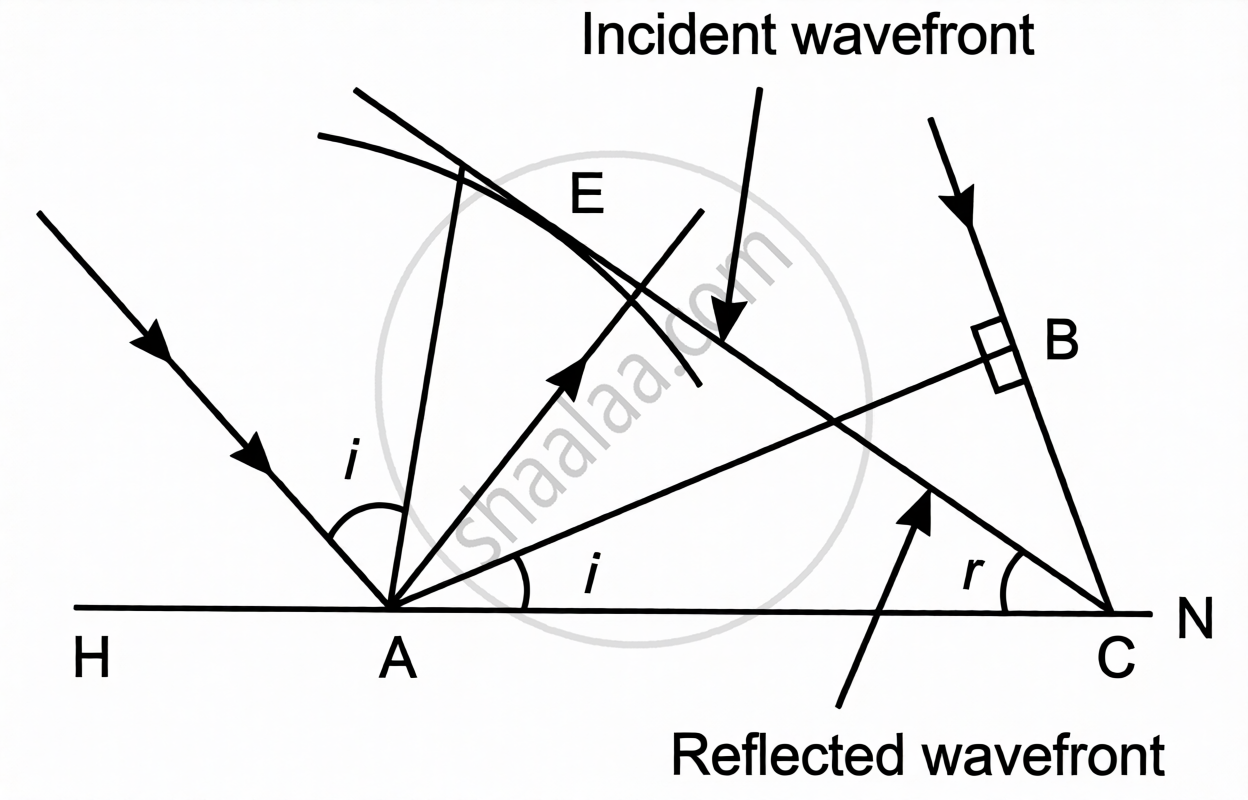
Consider a plane wave AB incident at an angle i on a reflecting surface MN. If v represents the speed of the wave in the medium and if T represents the time taken by the wavefront to advance from point B to C, then distance BC = vt.
In order to construct the reflected wavefront, a sphere of radius = vt is drawn from point A, as shown in the figure. Let CE represent the tangent plane drawn from the point C to this surface.
∴ AE = BC = vt
∠ABC = ∠CEA = 90°
Here, AC is common.
∴ ΔEAC ≅ ΔBAC
Hence i = r
संबंधित प्रश्न
Using Huygens's construction of secondary wavelets explain how a diffraction pattern is obtained on a screen due to a narrow slit on which a monochromatic beam of light is incident normally.
Consider a plane wave front incident on a thin convex lens. Draw a proper diagram to show how the incident wave front traverses through the lens and after refraction focusses on the focal point of the lens, giving the shape of the emergent wave front.
When the width of the slit is made double the original width, how would this affect the size and intensity of the central diffraction band?
Light waves travel in vacuum along the X-axis. Which of the following may represent the wave fronts?
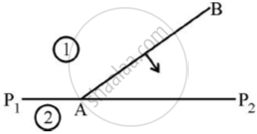
A plane wave front AB propagating from denser medium (1) into a rarer medium (2) is incident on the surface P1P2 separating the two media as shown in fig.
Using Huygen’s principle, draw the secondary wavelets and obtain the refracted wave front in the diagram.
The inverse square law of intensity is valid for a
Figure shows a standard two slit arrangement with slits S1, S2, P1, P2 are the two minima points on either side of P (Figure). At P2 on the screen, there is a hole and behind P2 is a second 2-slit arrangement with slits S3, S4 and a second screen behind them.

Which types of motion was Christiaan Huygens the first to analyse?
What did Christiaan Huygens discover about Saturn?
What did Huygens argue about the amplitude of secondary wavelets?
