Advertisements
Advertisements
प्रश्न
Consider a point at the focal point of a convergent lens. Another convergent lens of short focal length is placed on the other side. What is the nature of the wavefronts emerging from the final image?
Advertisements
उत्तर
Orientation of wavefront is perpendicular to ray. The ray diagram of the situation is shown in figure.

Parallel rays incident on lens L1 forms the image I2 at the focal point of the lens. This image acts as object for the lens L2 Now, due to the converging lens L2 , let final image formed is I which is point image. Hence the wavefront for this image will be of spherical symmetry.
APPEARS IN
संबंधित प्रश्न
Explain the construction of plane wavefront using Huygens’ principle.
What is the shape of the wavefront in the following case?
Light emerging out of a convex lens when a point source is placed at its focus.
What is the shape of the wavefront in the following case?
The portion of the wavefront of light from a distant star was intercepted by the Earth.
You have learnt in the text how Huygens’ principle leads to the laws of reflection and refraction. Use the same principle to deduce directly that a point object placed in front of a plane mirror produces a virtual image whose distance from the mirror is equal to the object distance from the mirror.
State Huygen’s principle.
Consider a plane wave front incident on a thin convex lens. Draw a proper diagram to show how the incident wave front traverses through the lens and after refraction focusses on the focal point of the lens, giving the shape of the emergent wave front.
Using this principle draw a diagram to show how a plane wave front incident at the interface of the two media gets refracted when it propagates from a rarer to a denser medium. Hence verify Snell's law of refraction.
When the width of the slit is made double the original width, how would this affect the size and intensity of the central diffraction band?
Light waves travel in vacuum along the X-axis. Which of the following may represent the wave fronts?
Derive the law of reflection using Huygen’s Wave Theory.
Define a wavefront. Using 'Huygens' principle, draw the shape of a refracted wavefront, when a plane wave is incident on a convex lens.
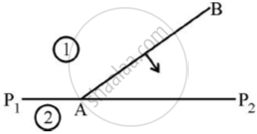
A plane wave front AB propagating from denser medium (1) into a rarer medium (2) is incident on the surface P1P2 separating the two media as shown in fig.
Using Huygen’s principle, draw the secondary wavelets and obtain the refracted wave front in the diagram.
Relation between ray and wavefront is ______.
What is the geometrical shape of the wavefront for:
- Light diverging from a point source?
- The pattern of wavefront of the light from a distant star intercepted by earth?
For light diverging from a point source ______.
- the wavefront is spherical.
- the intensity decreases in proportion to the distance squared.
- the wavefront is parabolic.
- the intensity at the wavefront does not depend on the distance.
Two light beams of intensities in the ratio of 9 : 4 are allowed to interfere. The ratio of the intensity of maxima and minima ______.
According to Huygens’s principle, the amplitude of secondary wavelets is ______.
How is a wavefront different from a ray?
