Advertisements
Advertisements
प्रश्न
For any prism, obtain a relation between the angle of the prism (A), the angle of minimum deviation (δm) and the refractive index of its material (μ or n).
Advertisements
उत्तर

In the given diagram,
OP is the incident ray, which makes the angle i, with normal, and QR is the angle of emergence, which is represented by i2. A is the prism angle, and it is the refractive index of the prism.
Now, we know that,
A = Prism angle, δ = Angle of deviation
i1 = Angle of incidence
i2 = Angle of emergent
In the case of minimum deviation
∠r1 = ∠r2 = ∠r
A = ∠r1 + ∠r2 = ∠2r
`=> ∠"r" = "A"/2`
Now again
A + δ = i1 + i2 ...(∵ In the case of minimum deviation)
i1 = i2 = i and δ = δm
So, A + δm = i + i = 2i
Now, `angle "i" = ("A" + delta_"m")/2`
For Snell's law:
`mu = (sin i)/(sin r)`
`=> mu = (sin ("A" + delta_m)/2)/(sin "A"/2)`
APPEARS IN
संबंधित प्रश्न
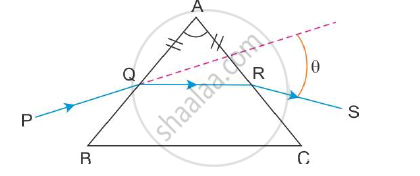
A ray PQ incident on the refracting face BA is refracted in the prism BAC as shown in the figure and emerges from the other refracting face AC as RS such that AQ = AR. If the angle of prism A = 60° and refractive index of material of prism is `sqrt3 `. Calculate angle θ.
A ray of light passes through an equilateral glass prism such that the angle of incidence is equal to the angle of emergence and each of these angles is equal to 3/4 of angle of prism. Find the angle of deviation.
Out of blue and red light which is deviated more by a prism? Give reason.
By properly combining two prisms made of different materials, it is possible to
(a) have dispersion without average deviation
(b) have deviation without dispersion
(c) have both dispersion and average deviation
(d) have neither dispersion nor average deviation
Two prisms of identical geometrical shape are combined with their refracting angles oppositely directed. The materials of the prisms have refractive indices 1.52 and 1.62 for violet light. A violet ray is deviated by 1.0° when passes symmetrically through this combination. What is the angle of the prisms?
A thin prism of angle 6.0°, ω = 0.07 and μy = 1.50 is combined with another thin prism having ω = 0.08 and μy = 1.60. The combination produces no deviation in the mean ray. (a) Find the angle of the second prism. (b) Find the net angular dispersion produced by the combination when a beam of white light passes through it. (c) If the prisms are similarly directed, what will be the deviation in the mean ray? (d) Find the angular dispersion in the situation described in (c).
The refractive index of a material M1 changes by 0.014 and that of another material M2 changes by 0.024 as the colour of the light is changed from red to violet. Two thin prisms, one made of M1(A = 5.3°) and the other made of M2(A = 3.7°) are combined with their refracting angles oppositely directed. (a) Find the angular dispersion produced by the combination. (b) The prisms are now combined with their refracting angles similarly directed. Find the angular dispersion produced by the combination.
In a regular prism, what is the relation between angle of incidence and angle of emergence when it is in the minimum deviation position?
How does the angle of minimum deviation of a glass prism vary if the incident violet light is replaced by red light?
The refractive indices of material for red, violet and yellow colour light are 1.52, 1.62 and 1.59 respectively.
Calculate the dispersive power of the material. If the mean deviation is 40°. What will be the angular dispersion produced by a prism of this material?
