ISC (Science)
Academic Year: 2025-2026
Date & Time: 16th March 2026, 2:00 pm
Duration: 3h
Advertisements
Instructions to Candidates
- You are allowed an additional fifteen minutes for only reading the question paper.
- You must NOT start writing during reading time.
- This question paper has 11 printed pages and one blank page.
- There are twenty questions in this paper. Answer all questions.
- There are four sections in the paper: A, B, C and D. Internal choices have been provided in two questions each in Sections B, C and D.
- Section A consists of one question having fourteen subparts of one mark each.
- While attempting Multiple Choice Questions in Section A, you are required to write only ONE option as the answer.
- Section B consists of seven questions of two marks each.
- Section C consists of nine questions of three marks each.
- Section D consists of three questions of five marks each.
- The intended marks for questions are given in brackets [ ].
- A list of useful constants and relations is given at the end of this paper.
- A simple scientific calculator without a programmable memory may be used for calculations.
Instruction to Supervising Examiner
- Kindly read aloud the Instructions given above to all the candidates present in the examination hall.
A fish called an electric eel can generate a voltage up to 800 V. If it can supply a current of 5 mA, the maximum power it can deliver is ______.
4000 W
400 W
40 W
4 W
Chapter:
A collimated beam of protons is travelling with a constant velocity along X-axis. There is a current carrying solenoid whose axis is also X-axis. If the beam now enters the solenoid along its axis, it will ______
describe a circular path.
get deflected along Z-axis.
get deflected along Y-axis.
continue to travel undeflected.
Chapter:
An electron, a proton, a deuteron and an alpha particle are all accelerated from rest through the same potential difference. Which one will have the maximum de Broglie wavelength?
Proton
Deuteron
Electron
Alpha particle
Chapter:
Magnetic susceptibility (χ) of a material is found to decrease with the rise in its temperature. The material is ______.
diamagnetic
paramagnetic
ferromagnetic
not magnetic
Chapter:
When a p-n junction diode is forward-biased, ______
it acts as an insulator and no current flows through it.
it offers a low resistance and a large current flows through it.
it offers a high resistance and a small current flows through it.
the width of depletion region increases.
Chapter:
When a biconvex lens of glass of refractive index 1.6 was dipped in a certain transparent liquid, it was found to behave like a plane sheet of glass. So, the refractive index of the liquid is ______.
1.0
1.4
1.5
1.6
Chapter:
Assertion: In Young’s double slit experiment, the first bright band for blue light is closer to the centre than the first bright band for green light.
Reason: Blue light has a longer wavelength than green light.
Both Assertion and Reason are true and Reason is the correct explanation for Assertion.
Both Assertion and Reason are true but Reason is not the correct explanation for Assertion.
Assertion is true and Reason is false.
Assertion is false and Reason is true.
Chapter:
Calculate the momentum of a photon having an energy of 4.8 × 10⁻¹⁹ J.
Chapter:
Calculate work done in moving a point charge ‘q’ through a distance ‘d’ along perpendicular bisector of an electric dipole, which consists of two-point charges −Q and +Q separated by a distance ‘L’.
Chapter:
A thin convex lens of power 5 D is kept in contact with a thin concave lens of power 8 D. Calculate the focal length of the combination.
Chapter:
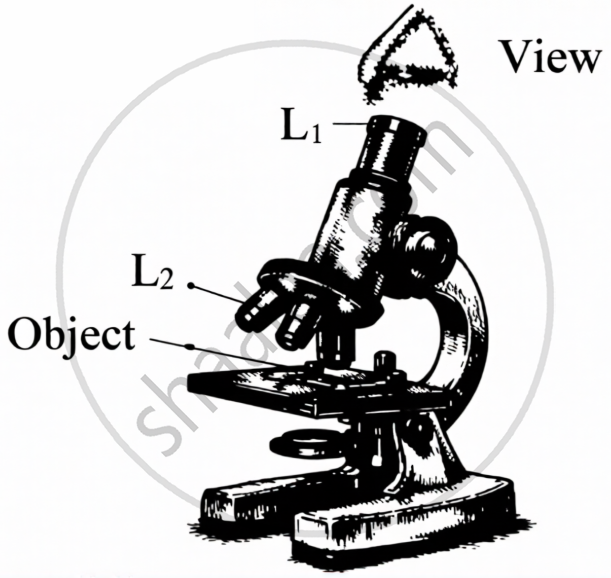
The image below shows a compound microscope. Which one of the two lenses L1 or L2 has a larger focal length?
Chapter:
Radius of the first Bohr orbit of hydrogen atom is 0.05 nm. Calculate the radius of the third orbit.
Chapter:
Four-point charges Q1 = +17.7 μC, Q2 = −8.85 μC, Q3 = −17.7 μC and Q4 = 35.4 μC are kept as shown in the figure below.
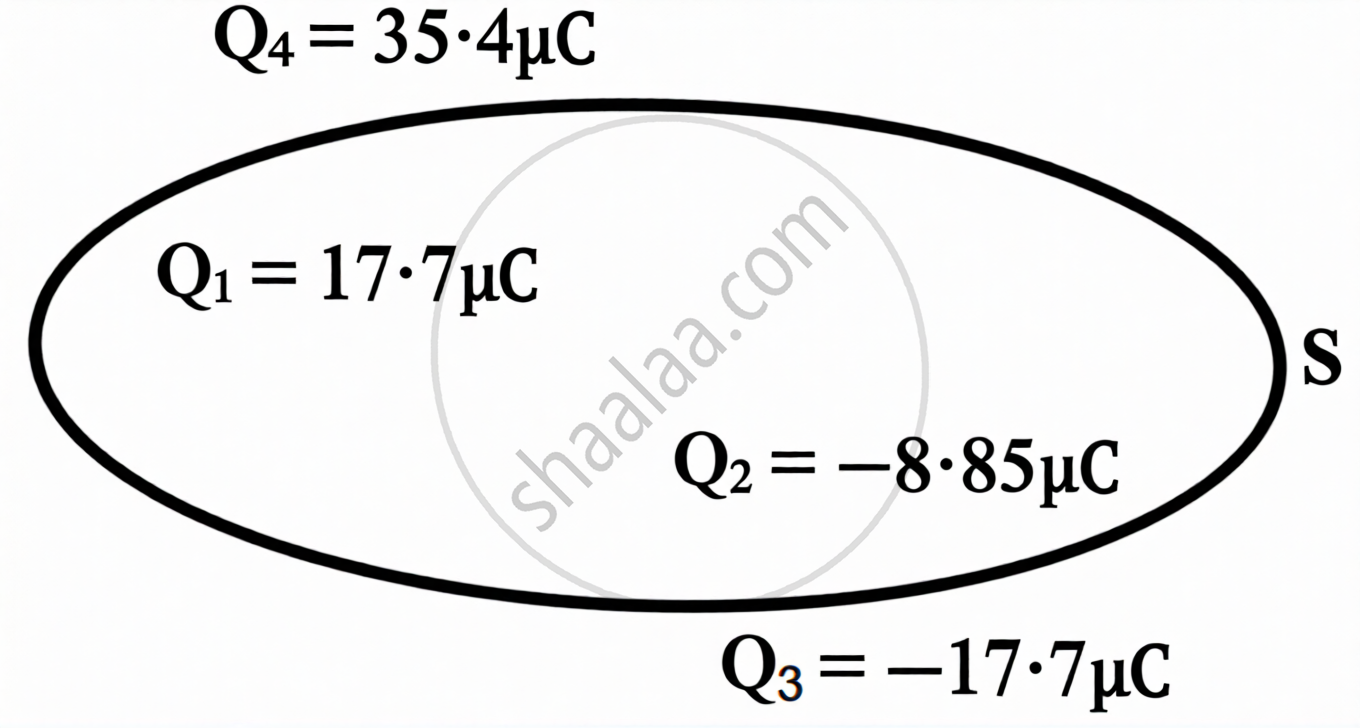
Calculate electric flux emanating from the closed surface S.
Chapter:
- Find the value of current ‘I’ in the figure given below.
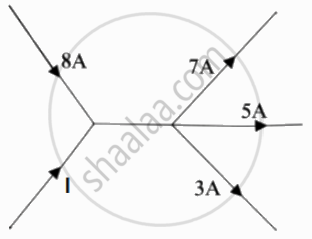
-
State the conservation principle on which your calculation is based.
Chapter:
Advertisements
You are provided with three identical capacitors, each of capacitance “C”.
If Cp is equivalent capacitance when they are connected in parallel and Cs is equivalent capacitance when they are connected in series, calculate the ratio `C_s/C_p`.
Chapter:
What is the effect of doubling the current flowing through a metallic wire on drift speed of free electrons?
Chapter:
What is the effect of doubling the current flowing through a metallic wire on relaxation time of free electrons?
Chapter:
Draw a labelled circuit diagram of a potentiometer used to compare emfs of two given cells X and Y. (Procedure and formula are not required.)
Chapter:
Write an expression of Biot-Savart law in vector form.
Chapter:
State Ampere’s circuital law.
Chapter: [4] Moving Charges and Magnetism
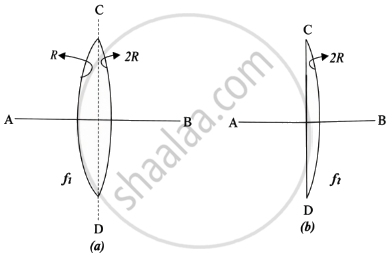
A bi-convex lens of focal length f1 is placed in air as shown in figure (a) below. The radii of curvature of its first and second surfaces are R and 2R respectively. The lens is cut along the plane CD. Compare the focal length f2 of the resulting lens shown in figure (b) with that of the original lens shown in figure (a).
Chapter:
Name the electromagnetic wave that scans the contents of the luggage of a traveller during a security check.
Chapter:
Which physical quantity is the same for UV rays, red light and radio waves when they are travelling in vacuum?
Chapter:
The work functions for metals M1 and M2 are 1.9 eV and 5.0 eV respectively. Perform necessary calculations to find out which metal emits photoelectrons, when monochromatic light of wavelength 410 nm is incident on them.
Chapter:
Show that the intensity of electric field at a point in end on position i.e., axial position of an electric dipole is given by:
`E = (1/(4πε_0))(2pr)/(r^2 - l^2)^2`
where the terms have their usual meaning.
Chapter:
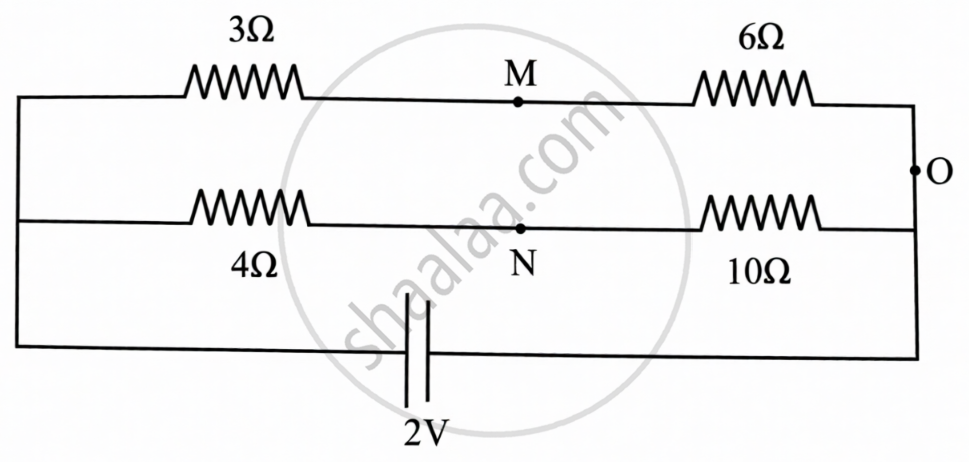
In the circuit shown in the figure below, how much resistance should be connected to a 10 Ω resistor so that the points M and N are at the same potential?
Chapter:
The figure below shows a battery consisting of three cells. Their emfs and internal resistances are also shown.
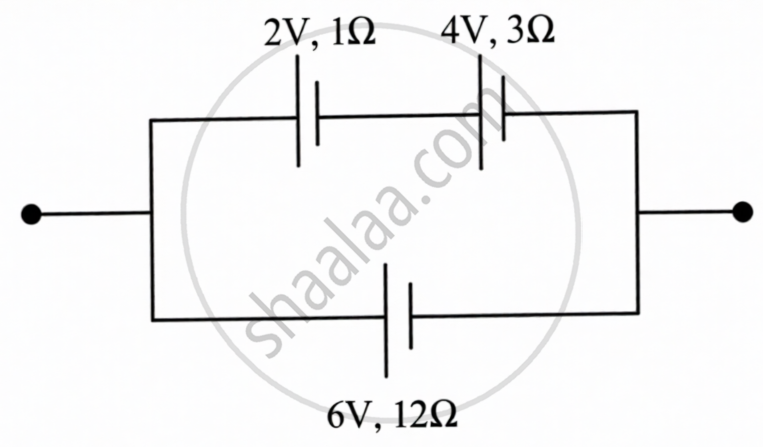
Calculate:
- Emf of the battery.
- Internal resistance of the battery.
Chapter:
Obtain an expression for magnetic flux density B at the centre of a circular coil of radius R, having N turns and carrying a current I.
Chapter:
Two moving coil galvanometers G1 and G2 are identical except for the following features:
| Features | G1 | G2 |
| Number of turns | 50 | 60 |
| Area of the coil | 30 cm2 | 40 cm2 |
| Resistance of the coil | 4 Ω | 6 Ω |
Perform calculations to determine which galvanometer has greater current sensitivity.
Chapter:
In a moving coil galvanometer, how is magnetic field made radial?
Chapter:
The figure below shows a long straight conductor X carrying a current I1. A point P is at a perpendicular distance ‘r1’ from it.
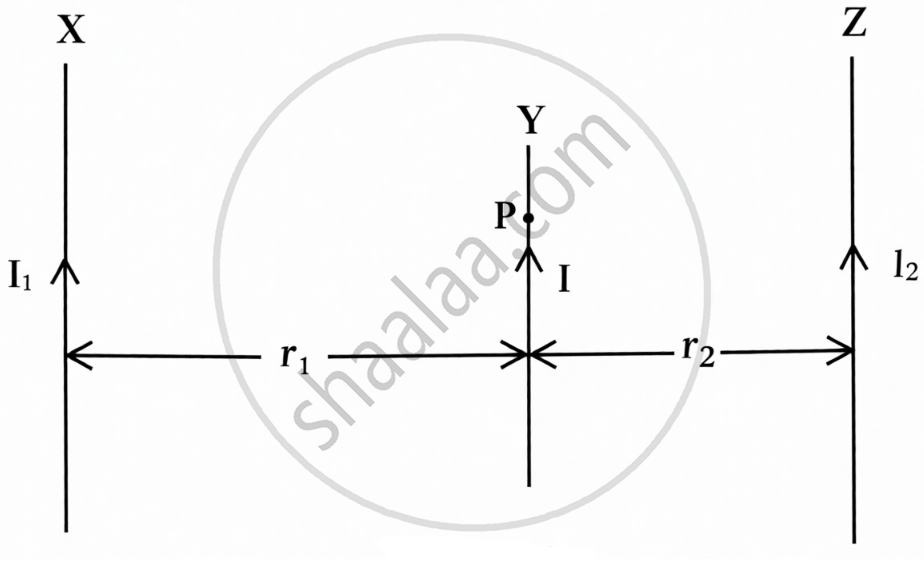
- How much force conductor X exerts on a short conductor Y of length ‘l’ which is carrying a current ‘I’ and is kept at point P parallel to the conductor X?
- Another long wire Z carrying a current I2 is now kept parallel to X and Y at a distance ‘r2’ from Y such that the conductor Y remains at rest. Obtain the relation between the currents I1 and I2.
Chapter:
A monochromatic ray of light incident on one refracting surface of an equilateral prism, suffers a deviation as shown in the figure below:
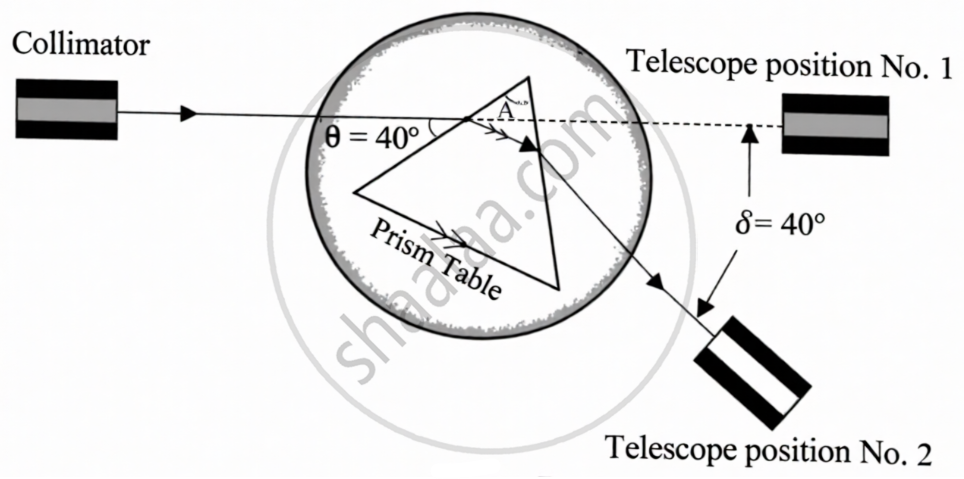
- Calculate the refractive index of the material of the prism.
- What is meant by dispersive power of a transparent material?
Chapter:
Advertisements
Draw a ray diagram of astronomical telescope for the final image formed at infinity.
Chapter:
Kabir and Neha conducted experiments on light as part of their school project. Both of them worked with the same source of monochromatic yellow light. Both obtained patterns on the screen which consisted of alternate bright and dark bands.
The images below depict their results.
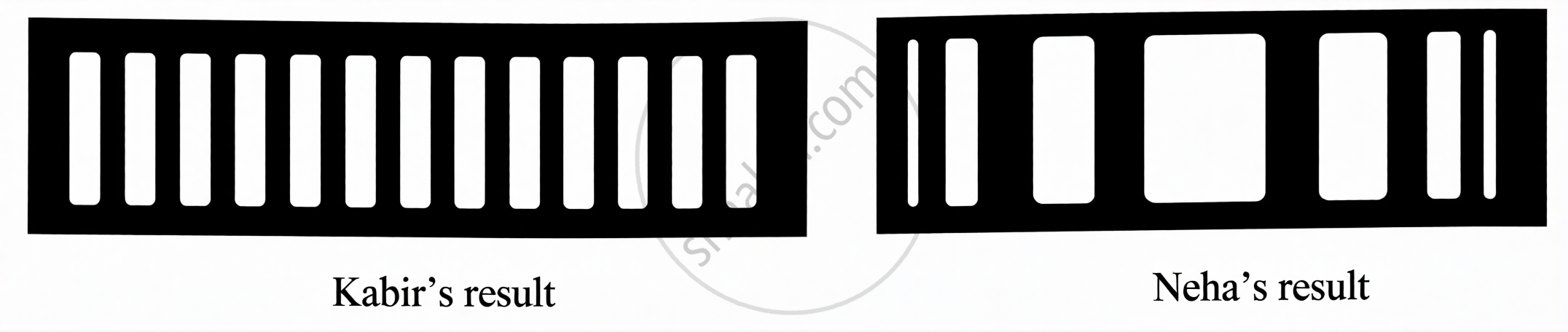
- Identify the phenomenon observed by Neha.
- The teacher asked Kabir to replace monochromatic yellow light with white light. What would be Kabir’s observation now?
- What conclusion would be drawn by Kabir and Neha about the nature of light?
Chapter:
Using Huygen’s wave theory of light, show that the angle of incidence is equal to the angle of reflection. Draw a neat and labelled diagram.
Chapter: [10] Wave Optics
The graphs below show the variation of stopping potential versus frequency of incident radiation for metals A and B.
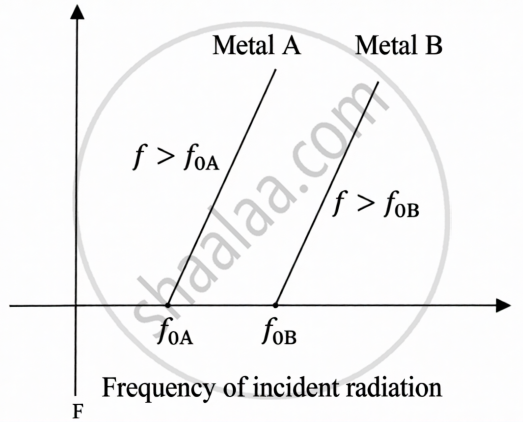
UV radiation of appropriate wavelength is allowed to fall on both the metals. Which metal will emit photoelectrons with higher maximum kinetic energy (Emax)? Give a reason.
Chapter:
What conclusion can be drawn from Davisson and Germer’s experiment?
Chapter:
When a coil is connected to a 200 V dc supply, the current flowing through it is found to be 1A. However, when it is connected to the 200 V, 50 Hz AC supply, the current is found to be 0.5 A.
- Explain why current flowing is less when the coil is connected to an AC supply.
- Calculate coefficient of self-inductance (L) of the coil.
Chapter:
The power factor of an a.c. circuit is 0.5. What is the phase difference between voltage and current in this circuit?
Chapter:
A 70 Ω resistor is connected to an AC source generating an emf ‘e’ given by e(V) = 495 Sin(100 πt).
Calculate rms value of the current (Irms) flowing through the resistor.
Chapter:
A 20 cm length of a long iron cored solenoid has 25 turns. If the area of cross section of the solenoid is 1 × 10⁻⁴ m2, calculate its coefficient of self-inductance (L).
Chapter:
State why soft iron is preferred to steel as a material for the core of a transformer.
Chapter:
Draw a labelled graph showing the variation of binding energy per nucleon with the mass number (A) of the nucleus. On it, mark the nucleus that is most stable.
Chapter:
What is meant by the statement ‘Angular momentum of an orbiting electron is quantised’?
Chapter:
Calculate the shortest wavelength of electromagnetic radiation present in Balmer series of hydrogen spectrum.
Chapter: [8] Electromagnetic Waves
Calculate the minimum amount of energy which a gamma ray photon should possess in order to produce a proton and an anti-proton pair.
Chapter:
Why nuclear fusion reaction is also called thermo-nuclear reaction?
Chapter: [13] Nuclei
What is the physical significance of the fact that total energy of an orbiting electron is negative?
Chapter:
State any two limitations of Bohr’s model for the hydrogen atoms.
Chapter:
Read the scenario given below and answer the questions that follow.
| Annie, a student of Physics, began her experiment by fabricating a p-n junction diode from an extrinsic semiconductor crystal, leading to the formation of a depletion region and a potential barrier at the interface. She then measured resistance of the diode in the linear region of the V-I characteristic curve. She also studied its characteristics during forward bias and reverse bias. Finally, she designed a circuit to convert AC voltage to DC voltage. |
- Which instrument was used by Annie to measure current flowing through the diode during its reverse bias?
- How did Annie obtain an extrinsic semiconductor from an intrinsic semiconductor?
- What is meant by potential barrier?
- Draw a labelled circuit diagram of a half wave rectifier.
Chapter:
Other Solutions
Submit Question Paper
Help us maintain new question papers on Shaalaa.com, so we can continue to help studentsonly jpg, png and pdf files
CISCE previous year question papers ISC Class 12 Physics (Theory) with solutions 2025 - 2026
Previous year Question paper for CISCE ISC Class 12 -2026 is solved by experts. Solved question papers gives you the chance to check yourself after your mock test.
By referring the question paper Solutions for Physics (Theory), you can scale your preparation level and work on your weak areas. It will also help the candidates in developing the time-management skills. Practice makes perfect, and there is no better way to practice than to attempt previous year question paper solutions of CISCE ISC Class 12.
How CISCE ISC Class 12 Question Paper solutions Help Students ?
• Question paper solutions for Physics (Theory) will helps students to prepare for exam.
• Question paper with answer will boost students confidence in exam time and also give you an idea About the important questions and topics to be prepared for the board exam.
• For finding solution of question papers no need to refer so multiple sources like textbook or guides.
