Advertisements
Advertisements
Question
Consider the situation described in the previous problem. Suppose the current i enters the loop at the points A and leaves it at the point B. Find the magnetic field at the centre of the loop.
Advertisements
Solution
The loop ABCD can be considered as a circuit with two resistances in parallel, one along branch AB and other along branch ADC.
As, the sides of the loop are identical, their resistances are also same.
Let the resistance of each side be r.
The resistance of branch AB = r
The resistance of branch ADC = 3r
The current in the branches are calculated as:
As current follow the least resistive path so
Current in branch AB = \[\frac{3i}{4}\]
Current in branch ADC = \[\frac{i}{4}\]
At the centre of the loop:
Magnetic field due to wire AD, DC and CB will be into the plane of paper according to right hand thumb rule.
Magnetic field due to wire AB will be out of the plane of paper according to right hand thumb rule.
Net magnetic field at the centre = BAD +BDC +BCB − BAB which will be out of the plane of paper.
As, perpendicular distance of the centre from every wire will be equal to \[\frac{a}{\sqrt{2}}\] and angle made by corner points of each side at the centre is \[45^\circ \] .
\[B_{AD} = \frac{\mu_0 (\frac{i}{4})}{4\pi(\frac{a}{\sqrt{2}})}(\sin45^\circ + \sin45^\circ )\]
\[ = \frac{\mu_0 i}{8\pi a}\]
\[ B_{AD} = B_{DC} = B_{CB} \]
\[ B_{AD} + B_{DC} + B_{CB} = B^, = \frac{3 \mu_0 i}{8\pi a}\]
\[ B_{AB} = \frac{\mu_0 (\frac{3i}{4})}{4\pi(\frac{a}{\sqrt{2}})}(\sin45^\circ + \sin45^\circ )\]
\[ = \frac{3 \mu_0 i}{8\pi a}\]
\[ B_{net} = B^, - B_{AB} \]
\[ = 0\]
APPEARS IN
RELATED QUESTIONS
Electron drift speed is estimated to be of the order of mm s−1. Yet large current of the order of few amperes can be set up in the wire. Explain briefly.
Using Ampere’s circuital law, obtain the expression for the magnetic field due to a long solenoid at a point inside the solenoid on its axis ?
A long straight wire of a circular cross-section of radius ‘a’ carries a steady current ‘I’. The current is uniformly distributed across the cross-section. Apply Ampere’s circuital law to calculate the magnetic field at a point ‘r’ in the region for (i) r < a and (ii) r > a.
A long, straight wire carries a current. Is Ampere's law valid for a loop that does not enclose the wire, or that encloses the wire but is not circular?
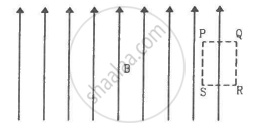
Sometimes we show an idealised magnetic field which is uniform in a given region and falls to zero abruptly. One such field is represented in figure. Using Ampere's law over the path PQRS, show that such a field is not possible.
Two large metal sheets carry currents as shown in figure. The current through a strip of width dl is Kdl where K is a constant. Find the magnetic field at the points P, Q and R.
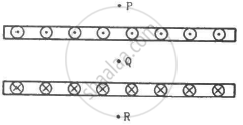
Consider the situation of the previous problem. A particle having charge q and mass mis projected from the point Q in a direction going into the plane of the diagram. It is found to describe a circle of radius r between the two plates. Find the speed of the charged particle.
Using Ampere's circuital law, obtain an expression for the magnetic flux density 'B' at a point 'X' at a perpendicular distance 'r' from a long current-carrying conductor.
(Statement of the law is not required).
Define ampere.
Two identical current carrying coaxial loops, carry current I in opposite sense. A simple amperian loop passes through both of them once. Calling the loop as C, then which statement is correct?
A thick current carrying cable of radius ‘R’ carries current ‘I’ uniformly distributed across its cross-section. The variation of magnetic field B(r) due to the cable with the distance ‘r’ from the axis of the cable is represented by ______
Read the following paragraph and answer the questions.
|
Consider the experimental set-up shown in the figure. This jumping ring experiment is an outstanding demonstration of some simple laws of Physics. A conducting non-magnetic ring is placed over the vertical core of a solenoid. When current is passed through the solenoid, the ring is thrown off. |

- Explain the reason for the jumping of the ring when the switch is closed in the circuit.
- What will happen if the terminals of the battery are reversed and the switch is closed? Explain.
- Explain the two laws that help us understand this phenomenon.
Using Ampere’s circuital law, obtain an expression for magnetic flux density ‘B’ at a point near an infinitely long and straight conductor, carrying a current I.
Which law provides a simpler alternative method for finding the magnetic field \[B\] when the current distribution has symmetry (straight wire, solenoid, toroid)?
Ampere's Circuital Law is the magnetic analogue of which law in electrostatics?
The SI unit of electric current, the ampere (A), is named in honour of:
Substituting \[B=\frac{\mu_0 I}{2\pi r}\] into \[\oint\vec{B}\cdot d\vec{l}=B(2\pi r)\] for a straight wire yields:
