Advertisements
Advertisements
Question
When current flowing through a solenoid decreases from 5A to 0 in 20 milliseconds, an emf of 500V is induced in it.
- What is this phenomenon called?
- Calculate coefficient of self-inductance of the solenoid.
Advertisements
Solution
1. The phenomenon is called self-induction.
2. ΔI = (5 – 0) A = 5 A, Δt = 20 × 10-3 sec.
`e = L (ΔI)/(Δt)`
`L = e × (Δt)/(ΔI)`
= `(500 xx 20 xx 10^(-3))/5 "H"`
= 2H
APPEARS IN
RELATED QUESTIONS
Consider the situation described in the previous problem. Suppose the current i enters the loop at the points A and leaves it at the point B. Find the magnetic field at the centre of the loop.
A long, cylindrical wire of radius b carries a current i distributed uniformly over its cross section. Find the magnitude of the magnetic field at a point inside the wire at a distance a from the axis.
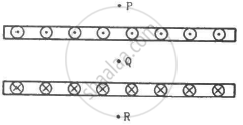
Two large metal sheets carry currents as shown in figure. The current through a strip of width dl is Kdl where K is a constant. Find the magnetic field at the points P, Q and R.
What is magnetic permeability?
A solenoid of length 0.6 m has a radius of 2 cm and is made up of 600 turns If it carries a current of 4 A, then the magnitude of the magnetic field inside the solenoid is:
A thick current carrying cable of radius ‘R’ carries current ‘I’ uniformly distributed across its cross-section. The variation of magnetic field B(r) due to the cable with the distance ‘r’ from the axis of the cable is represented by ______
Ampere's Circuital Law is the magnetic analogue of which law in electrostatics?
According to Ampere's Circuital Law, the line integral \[\oint\vec{B}\cdot d\vec{l}\] taken around any closed loop equals:
