Advertisements
Advertisements
Question
Two identical current carrying coaxial loops, carry current I in an opposite sense. A simple amperian loop passes through both of them once. Calling the loop as C ______.
- `oint B.dl = +- 2μ_0I`
- the value of `oint B.dl` is independent of sense of C.
- there may be a point on C where B and dl are perpendicular.
- B vanishes everywhere on C.
Options
a and b
a and c
b and c
c and d
Advertisements
Solution
b and c
Explanation:
Ampere’s law gives another method to calculate the magnetic field due to a given current distribution.
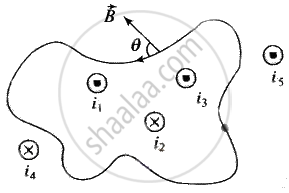
Line integral of the magnetic field `vecB` around any closed curve is equal to μ0 times the net current i threading through the area enclosed by the curve, i.e.
`oint vecB * vec(dl) = mu_0 sumi = mu_0 (i_1 + i_3 - i_2)`
Total current crossing the above area is `(i_1 + i_3 - i_2)`. Any current outside the area is not included in net current. (Outward ⊙ → + ve, Inward ⊗ → – ve)
Applying the Ampere's circuital law, we have
`ointB* dl = i_0 (I - I) = 0` (because current is in opposite sense)
Also, there may be a point on C where B and dl are perpendicular and hence, `oint_c B*dl = 0`
APPEARS IN
RELATED QUESTIONS
State Ampere’s circuital law.
State Ampere’s circuital law.
Obtain an expression for magnetic induction along the axis of the toroid.
Explain Ampere’s circuital law.
A long straight wire of a circular cross-section of radius ‘a’ carries a steady current ‘I’. The current is uniformly distributed across the cross-section. Apply Ampere’s circuital law to calculate the magnetic field at a point ‘r’ in the region for (i) r < a and (ii) r > a.
In order to have a current in a long wire, it should be connected to a battery or some such device. Can we obtain the magnetic due to a straight, long wire by using Ampere's law without mentioning this other part of the circuit?
A long, cylindrical tube of inner and outer radii a and b carries a current i distributed uniformly over its cross section. Find the magnitude of the magnitude filed at a point (a) just inside the tube (b) just outside the tube.
What is magnetic permeability?
State Ampere’s circuital law.
A straight wire of diameter 0.5 mm carrying a current of 1 A is replaced by another wire of 1 mm diameter carrying the same current. The strength of the magnetic field far away is ______.
A solenoid of length 0.6 m has a radius of 2 cm and is made up of 600 turns If it carries a current of 4 A, then the magnitude of the magnetic field inside the solenoid is:
A long solenoid having 200 turns per cm carries a current of 1.5 amp. At the centre of it is placed a coil of 100 turns of cross-sectional area 3.14 × 10⁻⁴ m2 having its axis parallel to the field produced by the solenoid. When the direction of current in the solenoid is reversed within 0.05 sec, the induced e.m.f. in the coil is:
Ampere's circuital law is used to find out ______
The given figure shows a long straight wire of a circular cross-section (radius a) carrying steady current I. The current I is uniformly distributed across this cross-section. Calculate the magnetic field in the region r < a and r > a.

Magnetic fields are produced by:
Which law provides a simpler alternative method for finding the magnetic field \[B\] when the current distribution has symmetry (straight wire, solenoid, toroid)?
Substituting \[B=\frac{\mu_0 I}{2\pi r}\] into \[\oint\vec{B}\cdot d\vec{l}=B(2\pi r)\] for a straight wire yields:
