Advertisements
Advertisements
Question
A long, cylindrical wire of radius b carries a current i distributed uniformly over its cross section. Find the magnitude of the magnetic field at a point inside the wire at a distance a from the axis.
Advertisements
Solution
Given:
Magnitude of current = i
Radius of the wire = b
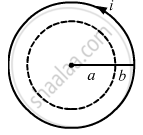
For a point at a distance a from the axis,
Current enclosed,
\[i' = \frac{i}{\pi b^2} \times \pi a^2\]
By Ampere's circuital law,
\[B \times 2\pi a = \mu_0 \frac{i}{\pi b^2} \times \pi a^2 \]
\[ \Rightarrow B = \frac{\mu_0 ia}{2\pi b^2}\]
APPEARS IN
RELATED QUESTIONS
Write Maxwell's generalization of Ampere's circuital law. Show that in the process of charging a capacitor, the current produced within the plates of the capacitor is `I=varepsilon_0 (dphi_E)/dt,`where ΦE is the electric flux produced during charging of the capacitor plates.
Write Maxwell's generalization of Ampere's circuital law. Show that in the process of charging a capacitor, the current produced within the plates of the capacitor is `I=varepsilon_0 (dphi_E)/dt,`where ΦE is the electric flux produced during charging of the capacitor plates.
State Ampere’s circuital law.
Electron drift speed is estimated to be of the order of mm s−1. Yet large current of the order of few amperes can be set up in the wire. Explain briefly.
A thin but long, hollow, cylindrical tube of radius r carries i along its length. Find the magnitude of the magnetic field at a distance r/2 from the surface (a) inside the tube (b) outside the tube.
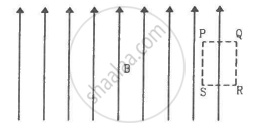
Sometimes we show an idealised magnetic field which is uniform in a given region and falls to zero abruptly. One such field is represented in figure. Using Ampere's law over the path PQRS, show that such a field is not possible.
Calculate the magnetic field inside and outside of the long solenoid using Ampere’s circuital law
Ampere’s circuital law is given by _______.
In a capillary tube, the water rises by 1.2 mm. The height of water that will rise in another capillary tube having half the radius of the first is:
A solenoid of length 0.6 m has a radius of 2 cm and is made up of 600 turns If it carries a current of 4 A, then the magnitude of the magnetic field inside the solenoid is:
A thick current carrying cable of radius ‘R’ carries current ‘I’ uniformly distributed across its cross-section. The variation of magnetic field B(r) due to the cable with the distance ‘r’ from the axis of the cable is represented by:
Using Ampere’s circuital law, obtain an expression for magnetic flux density ‘B’ at a point near an infinitely long and straight conductor, carrying a current I.
According to Ampere's Circuital Law, the line integral \[\oint\vec{B}\cdot d\vec{l}\] taken around any closed loop equals:
Substituting \[B=\frac{\mu_0 I}{2\pi r}\] into \[\oint\vec{B}\cdot d\vec{l}=B(2\pi r)\] for a straight wire yields:
In the sign convention for Ampere's law, if the fingers of the right hand curl along the direction of integration (\[d\vec{l}\]), the thumb points:
According to the right-hand rule sign convention for Ampere's law, currents flowing in the direction of the thumb are taken as ______ and currents flowing opposite to it are taken as ______.
