Advertisements
Advertisements
Question
Using Ampere’s circuital law, obtain the expression for the magnetic field due to a long solenoid at a point inside the solenoid on its axis ?
Advertisements
Solution
Solenoid
• It consists of an insulating long wire closely wound in the form of helix.
• Its length is large as compared to its diameter.
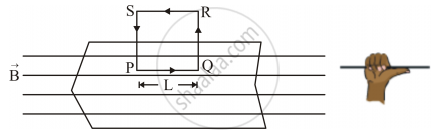
• Magnetic field due to RQ and SP path is zero because they are perpendicular to the axis of solenoid. Since SR is outside the solenoid, the magnetic field is zero.
• The line integral of magnetic field induction `vecB` over the closed path PQRS is
`oint_(PQRS) vecB*vecdl =oint_(PQ)vecB*vecdl =BL`
From Ampere’s circuital law,
`oint_(PQRS)vecB*vecdl = mu_0 `× Total current through rectangle PQRS
BL = μ0 × Number of turns in rectangle × Current
BL = μ0nLI
∴ B= μ0nI
APPEARS IN
RELATED QUESTIONS
Write Maxwell's generalization of Ampere's circuital law. Show that in the process of charging a capacitor, the current produced within the plates of the capacitor is `I=varepsilon_0 (dphi_E)/dt,`where ΦE is the electric flux produced during charging of the capacitor plates.
A long straight wire of a circular cross-section of radius ‘a’ carries a steady current ‘I’. The current is uniformly distributed across the cross-section. Apply Ampere’s circuital law to calculate the magnetic field at a point ‘r’ in the region for (i) r < a and (ii) r > a.
A hollow tube is carrying an electric current along its length distributed uniformly over its surface. The magnetic field
(a) increases linearly from the axis to the surface
(b) is constant inside the tube
(c) is zero at the axis
(d) is zero just outside the tube.
A long, cylindrical tube of inner and outer radii a and b carries a current i distributed uniformly over its cross section. Find the magnitude of the magnitude filed at a point (a) just inside the tube (b) just outside the tube.
State Ampere’s circuital law.
Define ampere.
The wires which connect the battery of an automobile to its starting motor carry a current of 300 A (for a short time). What is the force per unit length between the wires if they are 70 cm long and 1.5 cm apart? Is the force attractive or repulsive?
Which law provides a simpler alternative method for finding the magnetic field \[B\] when the current distribution has symmetry (straight wire, solenoid, toroid)?
In the sign convention for Ampere's law, if the fingers of the right hand curl along the direction of integration (\[d\vec{l}\]), the thumb points:
