Advertisements
Advertisements
Question
Outline the necessary steps to convert a galvanometer of resistance RG into an ammeter of a given range ?
Advertisements
Solution
Conversion of a galvanometer to ammeter
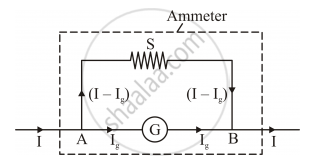
• A shunt (low resistance) is connected in parallel with the galvanometer.
`S = ((I_g)/(I -I_g))G`
Where,
I → Total current in circuit
G → Resistance of the galvanometer
S →Resistance of the shunt
Ig → Current through galvanometer
APPEARS IN
RELATED QUESTIONS
Show that the current flowing through a moving coil galvanometer is directly proportional to the angle of deflection of coil.
Figure shows two circuits each having a galvanometer and a battery of 3V.
When the galvanometers in each arrangement do not show any deflection, obtain the ratio R1/R2.

The coil of a moving coil galvanometer is wound over a metal frame in order to ______.
In an ammeter 0.5% of main current passes through galvanometer; If resistance of galvanometer is G, the resistance of ammeter will be.
A voltmeter has a range of 0 - 20 V and a resistance of 500 Q. Explain how can be used to measure voltages from 0 - 200 volt?
Current sensitivity of a galvanometer is defined as the:
The current sensitivity of a moving coil galvanometer is given by:
The unit of voltage sensitivity of a galvanometer is:
In the pivoted-coil (Weston) type galvanometer, the two hair springs:
In a circuit with a 3 V source and a 3 Ω resistor, the galvanometer \((R_G = 60\ \Omega)\) is converted into an ammeter using a shunt resistance \(r_s = 0.02\ \Omega\). The measured current is approximately:
