Advertisements
Advertisements
प्रश्न
Outline the necessary steps to convert a galvanometer of resistance RG into an ammeter of a given range ?
Advertisements
उत्तर
Conversion of a galvanometer to ammeter
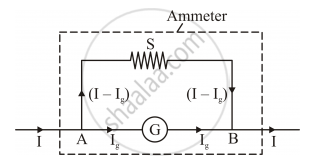
• A shunt (low resistance) is connected in parallel with the galvanometer.
`S = ((I_g)/(I -I_g))G`
Where,
I → Total current in circuit
G → Resistance of the galvanometer
S →Resistance of the shunt
Ig → Current through galvanometer
APPEARS IN
संबंधित प्रश्न
Why does a galvanometer when connected in series with a capacitor show a momentary deflection, when it is being charged or discharged?
How does this observation lead to modifying the Ampere's circuital law?
Hence write the generalised expression of Ampere's law.
Draw a labelled diagram of a moving coil galvanometer and explain its working. What is the function of radial magnetic field inside the coil?
State how a moving coil galvanometer can be converted into an ammeter.
A galvanometer coil has a resistance of 15 Ω and the metre shows full scale deflection for a current of 4 mA. How will you convert the metre into an ammeter of range 0 to 6 A?
A moving coil galvanometer can be converted into an ammeter by ______.
A galvanometer having a resistance of 20 Ω and 30 Ω division on both sides has figure of merit 0.005 ampere/division. The resistance that should be connected in series such that it can be used as a voltmeter upto 15 volt, is ______.
A voltmeter has a range of 0 - 20 V and a resistance of 500 Q. Explain how can be used to measure voltages from 0 - 200 volt?
At equilibrium, the deflecting and restoring torques acting on the coil of a moving coil galvanometer satisfy the condition:
A voltmeter is connected across a component:
In a circuit with a 3 V source and a 3 Ω resistor, the galvanometer \((R_G = 60\ \Omega)\) is converted into an ammeter using a shunt resistance \(r_s = 0.02\ \Omega\). The measured current is approximately:
