Advertisements
Advertisements
प्रश्न
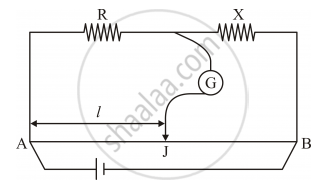
In the meter bridge experiment, balance point was observed at J with AJ = l.
(i) The values of R and X were doubled and then interchanged. What would be the new position of balance point?
(ii) If the galvanometer and battery are interchanged at the balance position, how will the alance point get affected?
Advertisements
उत्तर
(i) As the ratio of `R/X`is now interchanged by `(2X)/(2R) =X/R`, the new balance point will be = 100 − l = 100 − AJ `(as R/X =l/(100 -l))`
(ii)
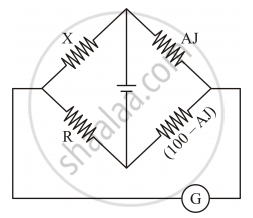
At the balance position there is no current flowing through the galvanometer. Hence, interchanging the battery and the galvanometer will have no effect on the balance point.
APPEARS IN
संबंधित प्रश्न
Explain, giving reasons, the basic difference in converting a galvanometer into (i) a voltmeter and (ii) an ammeter?
A galvanometer coil has a resistance of 12 Ω and the metre shows full scale deflection for a current of 3 mA. How will you convert the metre into a voltmeter of range 0 to 18 V?
A galvanometer coil has a resistance of 15 Ω and the metre shows full scale deflection for a current of 4 mA. How will you convert the metre into an ammeter of range 0 to 6 A?
The AC voltage across a resistance can be measured using a ______.
The coil of a moving coil galvanometer is wound over a metal frame in order to ______.
In an ammeter 0.5% of main current passes through galvanometer; If resistance of galvanometer is G, the resistance of ammeter will be.
A galvanometer having a resistance of 20 Ω and 30 Ω division on both sides has figure of merit 0.005 ampere/division. The resistance that should be connected in series such that it can be used as a voltmeter upto 15 volt, is ______.
The equilibrium condition \(NIAB = C\phi\) leads to the current–deflection relationship:
The pointer used to read the deflection on the calibrated scale of a moving coil galvanometer is made of:
A circuit consists of a 3 V source and a 3 Ω resistor. With an ideal ammeter of zero resistance inserted, the current in the circuit is:
