Advertisements
Advertisements
प्रश्न
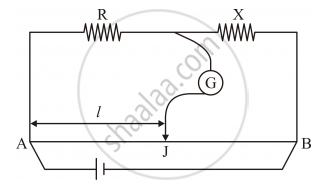
In the meter bridge experiment, balance point was observed at J with AJ = l.
(i) The values of R and X were doubled and then interchanged. What would be the new position of balance point?
(ii) If the galvanometer and battery are interchanged at the balance position, how will the alance point get affected?
Advertisements
उत्तर
(i) As the ratio of `R/X`is now interchanged by `(2X)/(2R) =X/R`, the new balance point will be = 100 − l = 100 − AJ `(as R/X =l/(100 -l))`
(ii)
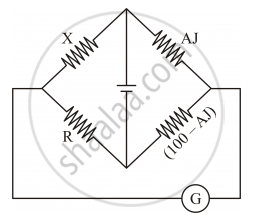
At the balance position there is no current flowing through the galvanometer. Hence, interchanging the battery and the galvanometer will have no effect on the balance point.
APPEARS IN
संबंधित प्रश्न
A rectangular coil of a moving coil galvanometer contains 50 turns each having area 12 cm2 . It is suspended in radial magnetic field 0.025 Wb/m2 by a fibre of twist constant 15 x10-10 Nm/degree. Calculate the sensitivity of the moving coil galvanometer.
Show that the current flowing through a moving coil galvanometer is directly proportional to the angle of deflection of coil.
Can a galvanometer as such be used for measuring the current? Explain.
State the principle of the working of a moving coil galvanometer, giving its labeled diagram ?
Explain the significance of a radial magnetic field when a current-carrying coil is kept in it.
A galvanometer having a coil resistance of 60 Ω shows full-scale deflection when a current of 1.0 amp passes through it. It can be converted into an ammeter to read currents up to 5.0 amp by:
The figure of merit k of a galvanometer is given by:
When a current-carrying coil of N turns and area A, carrying current I, is placed in a magnetic field B, the magnitude of the magnetic torque acting on it is:
In the pivoted-coil (Weston) type galvanometer, the two hair springs:
An ammeter, ideally, has:
