Advertisements
Advertisements
Question
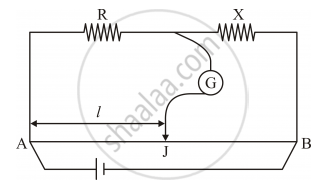
In the meter bridge experiment, balance point was observed at J with AJ = l.
(i) The values of R and X were doubled and then interchanged. What would be the new position of balance point?
(ii) If the galvanometer and battery are interchanged at the balance position, how will the alance point get affected?
Advertisements
Solution
(i) As the ratio of `R/X`is now interchanged by `(2X)/(2R) =X/R`, the new balance point will be = 100 − l = 100 − AJ `(as R/X =l/(100 -l))`
(ii)
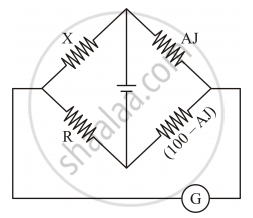
At the balance position there is no current flowing through the galvanometer. Hence, interchanging the battery and the galvanometer will have no effect on the balance point.
APPEARS IN
RELATED QUESTIONS
Why does a galvanometer show a momentary deflection at the time of charging or discharging a capacitor? Write the necessary expression to explain this observation.
What are the advantages of using soft iron as a core, instead of steel, in the coils of galvanometers?
When a galvanometer is shunted with a 4 Ω resistance, the deflection is reduced to one-fifth. If the galvanometer is further shunted with a 2 Ω wire. The further reduction (find the ratio of decrease in current to the previous current) in the deflection will be (the main current remains the same)
A resistance of 3Ω is connected in parallel to a galvanometer of resistance 297Ω. Find the fraction of current passing through the galvanometer.
A sensitive electromagnetic instrument used to detect and measure small electric currents (of the order of microamperes to milliamperes) by measuring the deflection of a current-carrying coil placed in a uniform magnetic field is called a:
Current sensitivity of a galvanometer is defined as the:
Voltage sensitivity of a galvanometer is defined as the:
The unit of voltage sensitivity of a galvanometer is:
At equilibrium, the deflecting and restoring torques acting on the coil of a moving coil galvanometer satisfy the condition:
The pointer used to read the deflection on the calibrated scale of a moving coil galvanometer is made of:
