Advertisements
Advertisements
प्रश्न
A galvanometer coil has a resistance of 15 Ω and the metre shows full scale deflection for a current of 4 mA. How will you convert the metre into an ammeter of range 0 to 6 A?
Advertisements
उत्तर
Resistance of the galvanometer coil, G = 15 Ω
Current for which the galvanometer shows full scale deflection, Ig = 4 mA = 4 × 10⁻³ A
Range of the ammeter is 0, which needs to be converted to 6 A.
∴ Current, I = 6 A
A shunt resistor of resistance S is to be connected in parallel with the galvanometer to convert it into an ammeter. The value of S is given as:
S = `("I"_"g""G")/("I" - "I"_"g")`
= `(4 xx 10^-3 xx 15)/(6 - 4 xx 10^-3)`
S = `(6 xx 10^-2)/(6 - 0.004)`
= `0.06/5.996`
≈ 0.01 Ω = 10 mΩ
Hence, a 10 mΩ shunt resistor is to be connected in parallel with the galvanometer.
APPEARS IN
संबंधित प्रश्न
Show that the current flowing through a moving coil galvanometer is directly proportional to the angle of deflection of coil.
A galvanometer of resistance G is converted into a voltmeter to measure upto V volts by connecting a resistance R1 in series with the coil. If a resistance R2 is connected in series with it, then it can measures upto V/2 volts. Find the resistance, in terms of R1 and R2, required to be connected to convert it into a voltmeter that can read upto 2 V. Also find the resistance G of the galvanometer in terms of R1 and R2
Draw a labelled diagram of a moving coil galvanometer. Describe briefly its principle and working.
Explain how moving coil galvanometer is converted into a voltmeter. Derive the necessary formula.
How will you convert a moving coil galvanometer into a voltmeter?
Define current sensitivity of a galvanometer.
Why does a galvanometer when connected in series with a capacitor show a momentary deflection, when it is being charged or discharged?
How does this observation lead to modifying the Ampere's circuital law?
Hence write the generalised expression of Ampere's law.
Draw a labelled diagram of a moving coil galvanometer and explain its working. What is the function of radial magnetic field inside the coil?
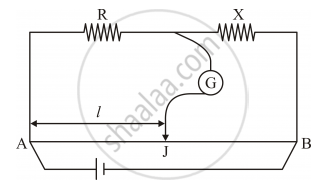
In the meter bridge experiment, balance point was observed at J with AJ = l.
(i) The values of R and X were doubled and then interchanged. What would be the new position of balance point?
(ii) If the galvanometer and battery are interchanged at the balance position, how will the alance point get affected?
Outline the necessary steps to convert a galvanometer of resistance RG into an ammeter of a given range ?
In an ammeter 0.5% of main current passes through galvanometer; If resistance of galvanometer is G, the resistance of ammeter will be.
A multirange current meter can be constructed by using a galvanometer circuit as shown in figure. We want a current meter that can measure 10 mA, 100 mA and 1A using a galvanometer of resistance 10 Ω and that prduces maximum deflection for current of 1mA. Find S1, S2 and S3 that have to be used

A galvanometer shows full-scale deflection for current Ig. A resistance R1 is required to convert it into a voltmeter of range (0 - V) and a resistance R2 to convert it into a voltmeter of range (0 - 2V). Find the resistance of the galvanometer.
To convert a moving coil galvanometer into an ammeter we need to connect a ______.
Assertion: When an electric current is passed through a moving coil galvanometer, its coil gets deflected.
Reason: A circular coil produces a uniform magnetic field around itself when an electric current is passed through it.
The voltage sensitivity of a moving coil galvanometer, where G is the resistance of the galvanometer coil, is given by:
The unit of voltage sensitivity of a galvanometer is:
At equilibrium, the deflecting and restoring torques acting on the coil of a moving coil galvanometer satisfy the condition:
A voltmeter is connected across a component:
