Advertisements
Advertisements
प्रश्न
Figure shows two circuits each having a galvanometer and a battery of 3V.
When the galvanometers in each arrangement do not show any deflection, obtain the ratio R1/R2.

Advertisements
उत्तर
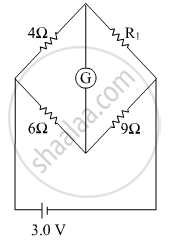
For balanced wheat stone bridge, there will be no deflection in the galvanometer.
`4/R_1 = 6/9 => R_1 =(4 xx 9)/6 = 6Ω`
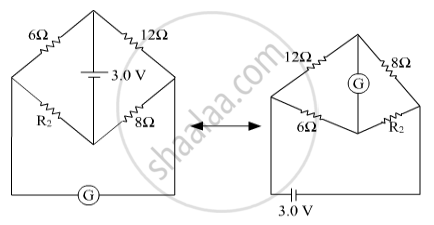
For the equivalent circuit, when the wheat stone bridge is balanced, there will be no deflection in the galvanometer.
`therefore 12/8 = 6/R_2 => R_2 \ ( 6xx 8)/12 = 4 Ω`
`therefore R_1/R_2 = 6/4 = 3/2`
संबंधित प्रश्न
The combined resistance of a galvanometer of resistance 500Ω and its shunt is 21Ω. Calculate the value of shunt.
Explain how moving coil galvanometer is converted into a voltmeter. Derive the necessary formula.
What are the advantages of using soft iron as a core, instead of steel, in the coils of galvanometers?
State how a moving coil galvanometer can be converted into an ammeter.
The current sensitivity of a galvanometer is defined as ______.
A multirange voltmeter can be constructed by using a galvanometer circuit as shown in figure. We want to construct a voltmeter that can measure 2V, 20V and 200V using a galvanometer of resistance 10Ω and that produces maximum deflection for current of 1 mA. Find R1, R2 and R3 that have to be used.

A voltmeter has a range of 0 - 20 V and a resistance of 500 Q. Explain how can be used to measure voltages from 0 - 200 volt?
The current sensitivity of a moving coil galvanometer is given by:
The unit of voltage sensitivity of a galvanometer is:
A voltmeter is connected across a component:
