Advertisements
Advertisements
प्रश्न
Define the term ‘current sensitivity’ of a moving coil galvanometer.
Advertisements
उत्तर १
The current sensitivity of a galvanometer is defined as the deflection produced in the galvanometer when a unit current flows through it.
Mathematically, it can be given by:
IS = `(NBA)/k`
Where k is the couple per unit twist.
उत्तर २
Current sensitivity is defined as the deflection e per unit current.
संबंधित प्रश्न
An ideal voltmeter has _______.
(A) low resistance
(b) high resistance
(C) infinite resistance
(D) zero resistance
Why is it necessary to introduce a cylindrical soft iron core inside the coil of a galvanometer?
In the meter bridge experiment, balance point was observed at J with AJ = l.
(i) The values of R and X were doubled and then interchanged. What would be the new position of balance point?
(ii) If the galvanometer and battery are interchanged at the balance position, how will the alance point get affected?
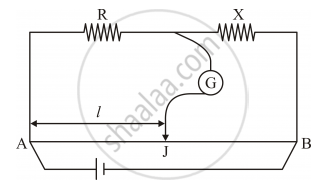
What are the advantages of using soft iron as a core, instead of steel, in the coils of galvanometers?
A coil of radius 10 cm and resistance 40 Ω has 1000 turns. It is placed with its plane vertical and its axis parallel to the magnetic meridian. The coil is connected to a galvanometer and is rotated about the vertical diameter through an angle of 180°. Find the charge which flows through the galvanometer if the horizontal component of the earth's magnetic field is BH = 3.0 × 10⁻⁵ T.
Explain the significance of a radial magnetic field when a current-carrying coil is kept in it.
A galvanometer coil has a resistance of 12 Ω and the metre shows full scale deflection for a current of 3 mA. How will you convert the metre into a voltmeter of range 0 to 18 V?
A voltmeter of variable ranges 3 V, 15 V, 150 V is to be designed by connecting resistances R1, R2, R3 in series with a galvanometer of resistance G = 20 Ω, as shown in Fig. The galvanometer gives full pass through its coil for 1 mA current i.e. "gives full pass through it's coil for 1 mA current". Then, the resistances R1, R2 and R3 (in kilo ohms) should be, respectively:

The figure of merit of a galvanometer is:
The current sensitivity of a moving coil galvanometer is given by:
