Advertisements
Advertisements
प्रश्न
Show that the current flowing through a moving coil galvanometer is directly proportional to the angle of deflection of coil.
Advertisements
उत्तर
a. Suppose that rectangular coil PQRS is kept in uniform magnetic field of induction ‘B’. Let ‘n’ be the number of turns of the coil with ‘l’ as its length and ‘b’ as its breadth. The current ‘I’ is passed through it in anticlockwise direction.
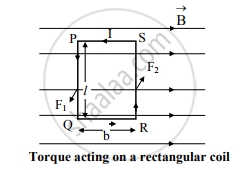
b. The forces on QR and SP are equal to zero because they are parallel to B→
c. Force on PQ,
F1 = nIBl (directed normally outwards)
Force on RS,
F2 = nIBl (directed normally inwards)
d. Two forces F1 and F2 are equal in magnitude but opposite in direction and act at different points. Hence these forces constitute a torque (τ) and rotate the coil.
e. Magnitude of torque is given by,
τ = Magnitude of one of the forces × perpendicular distance between these parallel forces
∴ τ = (nBIl) (b) = nBI (lb)
∴ τ = nBIA
where, A = lb = area of rectangular coil PQRS
f. This torque deflects the coil hence it is called deflecting torque. It is given by,
τd = nBIA ….(i)
This torque causes the pointer attached to the coil to deflect and move on a graduated scale.
g. As the coil is deflected, the phosphor bronze wire is twisted. This twist in phosphor bronze wire provides restoring or controlling torque.
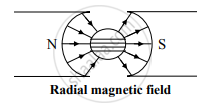
h. This restoring torque is directly proportional to the deflection of the coil.
i.e. τr ∝ θ
∴ τr = Cθ ….(ii)
where, the constant of proportionality C is called twist constant or restoring torque per unit twist.
i. For equilibrium of the coil, τd = τr
∴ nBIA = Cθ
∴ I = (C/nAB)θ .…(iii)
Equation (iii) represents the current flowing through M.C.G
j. For a given M.C.G., n, B, A are constant and for given suspension fibre
C = constant.
∴ C/nAB= k = constant
∴ I = kθ
∴ I ∝ θ
Hence, current flowing through galvanometer is proportional to deflection produced in it.
APPEARS IN
संबंधित प्रश्न
The combined resistance of a galvanometer of resistance 500Ω and its shunt is 21Ω. Calculate the value of shunt.
Why is it necessary to introduce a cylindrical soft iron core inside the coil of a galvanometer?
Increasing the current sensitivity of a galvanometer may not necessarily increase its voltage sensitivity. Explain, giving reason.
Two moving coil meters, M1 and M2 have the following particulars:
R1 = 10 Ω, N1 = 30,
A1 = 3.6 × 10⁻³ m2, B1 = 0.25 T
R2 = 14 Ω, N2 = 42,
A2 = 1.8 × 10⁻³ m2, B2 = 0.50 T
(The spring constants are identical for the two meters.)
Determine the ratio of
- current sensitivity and
- voltage sensitivity of M2 and M1.
A rectangular coil of a moving coil galvanometer contains 100 turns, each having area
15 cm2. It is suspended in the radial magnetic field 0.03 T. The twist constant of suspension
fibre is 15 x 10-10 N-m/degree. Calculate the sensitivity of the moving coil galvanometer.
The fraction of the total current passing through the galvanometer is ............ .
a) `S/(S+G)`
b) `G/(S+G)`
c) `(S+G)/G`
d) `(S+G)/S`
A moving coil galvanometer has a resistance of 25Ω and gives a full scale deflection for a current of 10mA. How will you convert it into a voltmeter having range 0 - 100 V?
Define current sensitivity of a galvanometer.
Why does a galvanometer when connected in series with a capacitor show a momentary deflection, when it is being charged or discharged?
How does this observation lead to modifying the Ampere's circuital law?
Hence write the generalised expression of Ampere's law.
Define the current sensitivity of a galvanometer ?
Figure shows two circuits each having a galvanometer and a battery of 3V.
When the galvanometers in each arrangement do not show any deflection, obtain the ratio R1/R2.

Explain, giving reasons, the basic difference in converting a galvanometer into (i) a voltmeter and (ii) an ammeter?
State the principle of the working of a moving coil galvanometer, giving its labeled diagram ?
Outline the necessary steps to convert a galvanometer of resistance RG into an ammeter of a given range ?
What are the advantages of using soft iron as a core, instead of steel, in the coils of galvanometers?
A coil of radius 10 cm and resistance 40 Ω has 1000 turns. It is placed with its plane vertical and its axis parallel to the magnetic meridian. The coil is connected to a galvanometer and is rotated about the vertical diameter through an angle of 180°. Find the charge which flows through the galvanometer if the horizontal component of the earth's magnetic field is BH = 3.0 × 10⁻⁵ T.
Why are the pole pieces of a horseshoe magnet in a moving coil galvanometer made cylinder in shape?
A moving coil galvanometer has a coil of resistance 59 Ω. It shows a full-scale deflection for a current of 50 mA. How will you convert it to an ammeter having a range of 0 to 3A?
Explain the significance of a radial magnetic field when a current-carrying coil is kept in it.
Define the term ‘current sensitivity’ of a moving coil galvanometer.
In a moving coil galvanometer the deflection (Φ) on the scale by a pointer attached to the spring is ______.
A moving coil galvanometer can be converted into an ammeter by ______.
The conversion of a moving coil galvanometer into a voltmeter is done by ______.
Assertion (A): On Increasing the current sensitivity of a galvanometer by increasing the number of turns may not necessarily increase its voltage sensitivity.
Reason (R): The resistance of the coil of the galvanometer increases on increasing the number of turns.
Select the most appropriate answer from the options given below:
A galvanometer of resistance 100 Ω gives a full-scale deflection for a current of 10−5 A. To convert it into an ammeter capable of measuring up to 1 A we should connect a resistance of ______.
In an ammeter 0.5% of main current passes through galvanometer; If resistance of galvanometer is G, the resistance of ammeter will be.
The coil of galvanometer consists of 100 turns and effective area of 1 square cm. The restoring couple is 10-8 N-m/rad. The magnetic field between the pole pieces is 5T. The current sensitivity of this galvanometer will be ______.
A moving coil galvanometer has 150 equal divisions. Its current sensitivity is 10-divisions per milliampere and voltage sensitivity is 2 divisions per millivolt. In order that each division reads 1 volt, the resistance in ohms needed to be connected in series with the coil will be ______.
A galvanometer shows full-scale deflection for current Ig. A resistance R1 is required to convert it into a voltmeter of range (0 - V) and a resistance R2 to convert it into a voltmeter of range (0 - 2V). Find the resistance of the galvanometer.
Explain in brief the basic construction of a moving-coil table galvanometer whit a neat labelled diagram.
A moving coil galvanometer of resistance 55 Ω produces a full scale deflection for a current of 250 mA. How will you convert it into an ammeter with a range of 0 - 3A?
To convert a moving coil galvanometer into an ammeter we need to connect a ______.
Assertion: When an electric current is passed through a moving coil galvanometer, its coil gets deflected.
Reason: A circular coil produces a uniform magnetic field around itself when an electric current is passed through it.
A galvanometer of resistance 100 Ω gives a full-scale deflection for a potential difference of 200 mV.
- What must be the resistance connected to convert the galvanometer into an ammeter of the range 0-200 mA?
- Determine resistance of the ammeter.
A sensitive electromagnetic instrument used to detect and measure small electric currents (of the order of microamperes to milliamperes) by measuring the deflection of a current-carrying coil placed in a uniform magnetic field is called a:
The unit in which the current sensitivity of a galvanometer is expressed is:
The unit of voltage sensitivity of a galvanometer is:
Between two galvanometers, the one with the smaller figure of merit is:
When a current-carrying coil of N turns and area A, carrying current I, is placed in a magnetic field B, the magnitude of the magnetic torque acting on it is:
At equilibrium, the deflecting and restoring torques acting on the coil of a moving coil galvanometer satisfy the condition:
The poles of the permanent magnet used in a moving coil galvanometer are shaped as:
A voltmeter is connected across a component:
