Advertisements
Advertisements
प्रश्न
How is current sensitivity increased?
Briefly describe how the current sensitivity of a moving coil galvanometer can be increased.
Advertisements
उत्तर
A moving coil galvanometer's sensitivity can be enhanced by increasing the number of turns in the coil, the area of the coil, and the magnetic field, while decreasing the couple per unit twist of the suspension.
APPEARS IN
संबंधित प्रश्न
Explain, giving reasons, the basic difference in converting a galvanometer into (i) a voltmeter and (ii) an ammeter?
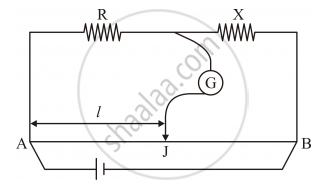
In the meter bridge experiment, balance point was observed at J with AJ = l.
(i) The values of R and X were doubled and then interchanged. What would be the new position of balance point?
(ii) If the galvanometer and battery are interchanged at the balance position, how will the alance point get affected?
State the principle of the working of a moving coil galvanometer, giving its labeled diagram ?
Assertion (A): On Increasing the current sensitivity of a galvanometer by increasing the number of turns may not necessarily increase its voltage sensitivity.
Reason (R): The resistance of the coil of the galvanometer increases on increasing the number of turns.
Select the most appropriate answer from the options given below:
A galvanometer having a coil resistance of 60 Ω shows full-scale deflection when a current of 1.0 amp passes through it. It can be converted into an ammeter to read currents up to 5.0 amp by:
A galvanometer coil bas 500 turns and each tum has an average area of 3 × 10⁻⁴ m2. If a torque of 1.5 Nm is required to keep this coil parallel to a magnetic field when a current of 0.5 A is flowing through it, the strength of the field (in T) is ______.
A resistance of 3Ω is connected in parallel to a galvanometer of resistance 297Ω. Find the fraction of current passing through the galvanometer.
The equilibrium condition \(NIAB = C\phi\) leads to the current–deflection relationship:
A voltmeter is connected across a component:
