Advertisements
Advertisements
प्रश्न
A multirange current meter can be constructed by using a galvanometer circuit as shown in figure. We want a current meter that can measure 10 mA, 100 mA and 1A using a galvanometer of resistance 10 Ω and that prduces maximum deflection for current of 1mA. Find S1, S2 and S3 that have to be used

Advertisements
उत्तर
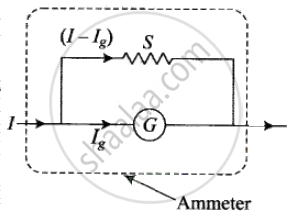
A galvanometer can be converted into ammeter by connecting a very low resistance wire (shunt S) connected in parallel with galvanometer. The relationship is given by IgG = (I – Ig) S, where Ig is the range of galvanometer and G is the resistance of galvanometer.
For measuring `I_1 = 10 mA: I_G.G = (I_1 - I_G)(S_1 + S_2 + S_3)`
For measuring `I_2 = 100 mA: I_G(G + S_1) = (I_2 - I_G)(S_2 + S_3)`
For measuring `I_3 = 1 A: I_G(G + S_1 + S_2) = (I_3 - I_G)(S_3)`
Gives `S_1 = 1 Ω, S_2 = 0.1 Ω`
And `S_3 = 0.01 Ω`
APPEARS IN
संबंधित प्रश्न
The combined resistance of a galvanometer of resistance 500Ω and its shunt is 21Ω. Calculate the value of shunt.
Obtain the expression for current sensitivity of moving coil galvanometer.
Explain, giving reasons, the basic difference in converting a galvanometer into (i) a voltmeter and (ii) an ammeter?
State how a moving coil galvanometer can be converted into an ammeter.
A moving coil galvanometer can be converted into an ammeter by ______.
A galvanometer having a coil resistance of 60 Ω shows full-scale deflection when a current of 1.0 amp passes through it. It can be converted into an ammeter to read currents up to 5.0 amp by:
A multirange voltmeter can be constructed by using a galvanometer circuit as shown in figure. We want to construct a voltmeter that can measure 2V, 20V and 200V using a galvanometer of resistance 10Ω and that produces maximum deflection for current of 1 mA. Find R1, R2 and R3 that have to be used.

When a galvanometer is shunted with a 4 Ω resistance, the deflection is reduced to one-fifth. If the galvanometer is further shunted with a 2 Ω wire. The further reduction (find the ratio of decrease in current to the previous current) in the deflection will be (the main current remains the same)
Explain in brief the basic construction of a moving-coil table galvanometer whit a neat labelled diagram.
A voltmeter has a range of 0 - 20 V and a resistance of 500 Q. Explain how can be used to measure voltages from 0 - 200 volt?
Assertion: When an electric current is passed through a moving coil galvanometer, its coil gets deflected.
Reason: A circular coil produces a uniform magnetic field around itself when an electric current is passed through it.
The figure below shows a circuit containing an ammeter A, a galvanometer G and a plug key K. When the key is closed:

Current sensitivity of a galvanometer is defined as the:
The figure of merit of a galvanometer is:
The voltage sensitivity of a moving coil galvanometer, where G is the resistance of the galvanometer coil, is given by:
At equilibrium, the deflecting and restoring torques acting on the coil of a moving coil galvanometer satisfy the condition:
An ammeter, ideally, has:
A circuit consists of a 3 V source and a 3 Ω resistor. With an ideal ammeter of zero resistance inserted, the current in the circuit is:
