Advertisements
Advertisements
Question
A multirange current meter can be constructed by using a galvanometer circuit as shown in figure. We want a current meter that can measure 10 mA, 100 mA and 1A using a galvanometer of resistance 10 Ω and that prduces maximum deflection for current of 1mA. Find S1, S2 and S3 that have to be used

Advertisements
Solution
A galvanometer can be converted into ammeter by connecting a very low resistance wire (shunt S) connected in parallel with galvanometer. The relationship is given by IgG = (I – Ig) S, where Ig is the range of galvanometer and G is the resistance of galvanometer.
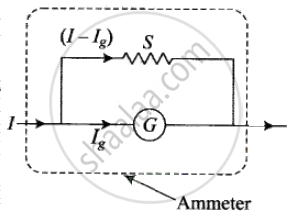
For measuring `I_1 = 10 mA: I_G.G = (I_1 - I_G)(S_1 + S_2 + S_3)`
For measuring `I_2 = 100 mA: I_G(G + S_1) = (I_2 - I_G)(S_2 + S_3)`
For measuring `I_3 = 1 A: I_G(G + S_1 + S_2) = (I_3 - I_G)(S_3)`
Gives `S_1 = 1 Ω, S_2 = 0.1 Ω`
And `S_3 = 0.01 Ω`
APPEARS IN
RELATED QUESTIONS
The combined resistance of a galvanometer of resistance 500Ω and its shunt is 21Ω. Calculate the value of shunt.
The combined resistance of a galvanometer of resistance 500Ω and its shunt is 21Ω. Calculate the value of shunt.
A circular coil of 250 turns and diameter 18 cm carries a current of 12A. What is the magnitude of magnetic moment associated with the coil?
- A circular coil of 30 turns and radius 8.0 cm carrying a current of 6.0 A is suspended vertically in a uniform horizontal magnetic field of magnitude 1.0 T. The field lines make an angle of 60° with the normal of the coil. Calculate the magnitude of the counter torque that must be applied to prevent the coil from turning.
- Would your answer change, if the circular coil in (a) were replaced by a planar coil of some irregular shape that encloses the same area? (All other particulars are also unaltered.)
The fraction of the total current passing through the galvanometer is ............ .
a) `S/(S+G)`
b) `G/(S+G)`
c) `(S+G)/G`
d) `(S+G)/S`
A galvanometer has a resistance of 16Ω. It shows full scale deflection, when a current of 20 mA is passed through it. The only shunt resistance available is 0.06 which is not appropriate to convert a galvanometer into an ammeter. How much resistance should be connected in series with the coil of galvanometer, so that the range of ammeter is 8 A?
Write current sensitivity of a galvanomete S.I. unit.
Figure shows two circuits each having a galvanometer and a battery of 3V.
When the galvanometers in each arrangement do not show any deflection, obtain the ratio R1/R2.

A coil of radius 10 cm and resistance 40 Ω has 1000 turns. It is placed with its plane vertical and its axis parallel to the magnetic meridian. The coil is connected to a galvanometer and is rotated about the vertical diameter through an angle of 180°. Find the charge which flows through the galvanometer if the horizontal component of the earth's magnetic field is BH = 3.0 × 10⁻⁵ T.
Why are the pole pieces of a horseshoe magnet in a moving coil galvanometer made cylinder in shape?
Define the term ‘current sensitivity’ of a moving coil galvanometer.
The conversion of a moving coil galvanometer into a voltmeter is done by ______.
In an ammeter 0.5% of main current passes through galvanometer; If resistance of galvanometer is G, the resistance of ammeter will be.
The coil of galvanometer consists of 100 turns and effective area of 1 square cm. The restoring couple is 10-8 N-m/rad. The magnetic field between the pole pieces is 5T. The current sensitivity of this galvanometer will be ______.
When a galvanometer is shunted with a 4 Ω resistance, the deflection is reduced to one-fifth. If the galvanometer is further shunted with a 2 Ω wire. The further reduction (find the ratio of decrease in current to the previous current) in the deflection will be (the main current remains the same)
The figure of merit of a galvanometer is:
The figure of merit k of a galvanometer is given by:
At equilibrium, the deflecting and restoring torques acting on the coil of a moving coil galvanometer satisfy the condition:
In the pivoted-coil (Weston) type galvanometer, the two hair springs:
