Advertisements
Advertisements
Question
- A circular coil of 30 turns and radius 8.0 cm carrying a current of 6.0 A is suspended vertically in a uniform horizontal magnetic field of magnitude 1.0 T. The field lines make an angle of 60° with the normal of the coil. Calculate the magnitude of the counter torque that must be applied to prevent the coil from turning.
- Would your answer change, if the circular coil in (a) were replaced by a planar coil of some irregular shape that encloses the same area? (All other particulars are also unaltered.)
Advertisements
Solution

(a) Number of turns on the circular coil, n = 30
Radius of the coil, r = 8.0 cm = 0.08 m
Area of the coil = πr2
= π(0.08)2
= 3.14 × 0.0064
= 0.0201 m2
Current flowing in the coil, I = 6.0 A
Magnetic field strength, B = 1 T
Angle between the field lines and normal with the coil surface,
θ = 60°
The coil experiences a torque in the magnetic field. Hence, it turns.
The counter torque applied to prevent the coil from turning is given by the relation,
τ = n IBA sin θ ...(i)
= 30 × 6 × 1 × 0.0201 × sin 60°
= `3.618 xx sqrt3/2`
= `3.618 xx 1.732/2`
= 3.618 × 0.866
= 3.133 N m
(b) It can be inferred from the relation (i) that the magnitude of the applied torque is not dependent on the shape of the coil. It depends on the area of the coil. Hence, the answer would not change if the circular coil in the above case is replaced by a planar coil of some irregular shape that encloses the same area.
RELATED QUESTIONS
Obtain the expression for current sensitivity of moving coil galvanometer.
Can a galvanometer as such be used for measuring the current? Explain.
How will you convert a moving coil galvanometer into a voltmeter?
With the help of a neat and labelled diagram, explain the principle and working of a moving coil galvanometer ?
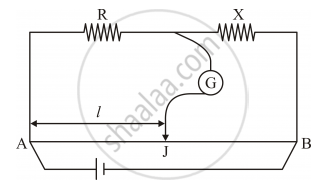
In the meter bridge experiment, balance point was observed at J with AJ = l.
(i) The values of R and X were doubled and then interchanged. What would be the new position of balance point?
(ii) If the galvanometer and battery are interchanged at the balance position, how will the alance point get affected?
State the principle of the working of a moving coil galvanometer, giving its labeled diagram ?
State the underlying principle of working of a moving coil galvanometer. Write two reasons why a galvanometer can not be used as such to measure current in a given circuit. Name any two factors on which the current sensitivity of a galvanometer depends.
Define the term ‘current sensitivity’ of a moving coil galvanometer.
A galvanometer coil has a resistance of 12 Ω and the metre shows full scale deflection for a current of 3 mA. How will you convert the metre into a voltmeter of range 0 to 18 V?
The conversion of a moving coil galvanometer into a voltmeter is done by ______.
A galvanometer shows full-scale deflection for current Ig. A resistance R1 is required to convert it into a voltmeter of range (0 - V) and a resistance R2 to convert it into a voltmeter of range (0 - 2V). Find the resistance of the galvanometer.
Explain in brief the basic construction of a moving-coil table galvanometer whit a neat labelled diagram.
A moving coil galvanometer of resistance 55 Ω produces a full scale deflection for a current of 250 mA. How will you convert it into an ammeter with a range of 0 - 3A?
A sensitive electromagnetic instrument used to detect and measure small electric currents (of the order of microamperes to milliamperes) by measuring the deflection of a current-carrying coil placed in a uniform magnetic field is called a:
Current sensitivity of a galvanometer is defined as the:
The figure of merit k of a galvanometer is given by:
The use of a radial magnetic field, in which \(\sin\theta = 1\) at all positions, produces a galvanometer scale deflection that is:
A circuit consists of a 3 V source and a 3 Ω resistor. With an ideal ammeter of zero resistance inserted, the current in the circuit is:
