Advertisements
Advertisements
Question
Figure shows two circuits each having a galvanometer and a battery of 3V.
When the galvanometers in each arrangement do not show any deflection, obtain the ratio R1/R2.

Advertisements
Solution
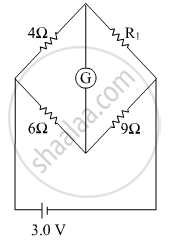
For balanced wheat stone bridge, there will be no deflection in the galvanometer.
`4/R_1 = 6/9 => R_1 =(4 xx 9)/6 = 6Ω`
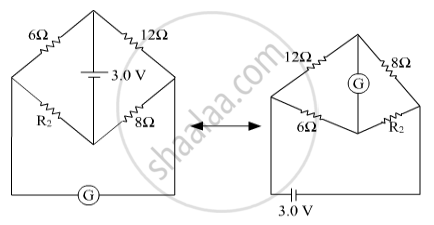
For the equivalent circuit, when the wheat stone bridge is balanced, there will be no deflection in the galvanometer.
`therefore 12/8 = 6/R_2 => R_2 \ ( 6xx 8)/12 = 4 Ω`
`therefore R_1/R_2 = 6/4 = 3/2`
RELATED QUESTIONS
Write the underlying principle of a moving coil galvanometer.
Increasing the current sensitivity of a galvanometer may not necessarily increase its voltage sensitivity. Explain, giving reason.
Define current sensitivity of a galvanometer.
A galvanometer coil bas 500 turns and each tum has an average area of 3 × 10⁻⁴ m2. If a torque of 1.5 Nm is required to keep this coil parallel to a magnetic field when a current of 0.5 A is flowing through it, the strength of the field (in T) is ______.
A moving coil galvanometer has 150 equal divisions. Its current sensitivity is 10-divisions per milliampere and voltage sensitivity is 2 divisions per millivolt. In order that each division reads 1 volt, the resistance in ohms needed to be connected in series with the coil will be ______.
A voltmeter has a range of 0 - 20 V and a resistance of 500 Q. Explain how can be used to measure voltages from 0 - 200 volt?
To convert a moving coil galvanometer into an ammeter we need to connect a ______.
Between two galvanometers, the one with the smaller figure of merit is:
In a circuit with a 3 V source and a 3 Ω resistor, the galvanometer \((R_G = 60\ \Omega)\) is converted into an ammeter using a shunt resistance \(r_s = 0.02\ \Omega\). The measured current is approximately:
