Advertisements
Advertisements
Question
Define current sensitivity of a galvanometer.
Advertisements
Solution
Current sensitivity of a galvanometer is defined as the deflection produced in the galvanometer when a unit current flows through it.
θ = `("nBA")/"k""I"`
So, for a given value of I, θ will be large if `("nBA")/"k"` is large i.e n, B and A should be large and k should be small.
APPEARS IN
RELATED QUESTIONS
How will you convert a moving coil galvanometer into a voltmeter?
Draw a labelled diagram of a moving coil galvanometer and explain its working. What is the function of radial magnetic field inside the coil?
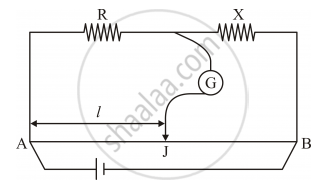
In the meter bridge experiment, balance point was observed at J with AJ = l.
(i) The values of R and X were doubled and then interchanged. What would be the new position of balance point?
(ii) If the galvanometer and battery are interchanged at the balance position, how will the alance point get affected?
A coil of radius 10 cm and resistance 40 Ω has 1000 turns. It is placed with its plane vertical and its axis parallel to the magnetic meridian. The coil is connected to a galvanometer and is rotated about the vertical diameter through an angle of 180°. Find the charge which flows through the galvanometer if the horizontal component of the earth's magnetic field is BH = 3.0 × 10⁻⁵ T.
A moving coil galvanometer has a coil of resistance 59 Ω. It shows a full-scale deflection for a current of 50 mA. How will you convert it to an ammeter having a range of 0 to 3A?
State how a moving coil galvanometer can be converted into an ammeter.
A moving coil galvanometer can be converted into an ammeter by ______.
Assertion (A): On Increasing the current sensitivity of a galvanometer by increasing the number of turns may not necessarily increase its voltage sensitivity.
Reason (R): The resistance of the coil of the galvanometer increases on increasing the number of turns.
Select the most appropriate answer from the options given below:
The figure below shows a circuit containing an ammeter A, a galvanometer G and a plug key K. When the key is closed:

