Advertisements
Advertisements
Question
Can a galvanometer as such be used for measuring the current? Explain.
Advertisements
Solution
Yes a galvanometer can be used for measuring the current
Conversion of a galvanometer into an ammeter
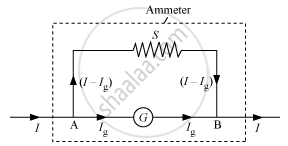
A shunt (low resistance) is connected in parallel with a galvanometer.
`S=(I_g/(I-I_g))G`
Here,
I = total current in circuit
G = resistance of the galvanometer
S = resistance of the shunt
Ig = current through the galvanometer
RELATED QUESTIONS
The combined resistance of a galvanometer of resistance 500Ω and its shunt is 21Ω. Calculate the value of shunt.
Two moving coil meters, M1 and M2 have the following particulars:
R1 = 10 Ω, N1 = 30,
A1 = 3.6 × 10⁻³ m2, B1 = 0.25 T
R2 = 14 Ω, N2 = 42,
A2 = 1.8 × 10⁻³ m2, B2 = 0.50 T
(The spring constants are identical for the two meters.)
Determine the ratio of
- current sensitivity and
- voltage sensitivity of M2 and M1.
Explain the significance of a radial magnetic field when a current-carrying coil is kept in it.
Define the term ‘current sensitivity’ of a moving coil galvanometer.
A galvanometer coil has a resistance of 15 Ω and the metre shows full scale deflection for a current of 4 mA. How will you convert the metre into an ammeter of range 0 to 6 A?
The AC voltage across a resistance can be measured using a ______.
A moving coil galvanometer of resistance 55 Ω produces a full scale deflection for a current of 250 mA. How will you convert it into an ammeter with a range of 0 - 3A?
Assertion: When an electric current is passed through a moving coil galvanometer, its coil gets deflected.
Reason: A circular coil produces a uniform magnetic field around itself when an electric current is passed through it.
The figure below shows a circuit containing an ammeter A, a galvanometer G and a plug key K. When the key is closed:

