Advertisements
Advertisements
Question
A multirange voltmeter can be constructed by using a galvanometer circuit as shown in figure. We want to construct a voltmeter that can measure 2V, 20V and 200V using a galvanometer of resistance 10Ω and that produces maximum deflection for current of 1 mA. Find R1, R2 and R3 that have to be used.

Advertisements
Solution
The galvanometer can also be used as a voltmeter to measure the voltage across a given section of the circuit. For this, a very high resistance wire is to be connected in series with galvanometer. The relationship is given by Ig (G + R) – V where Ig is the range of galvanometer, G is the resistance of galvanometer and R is the resistance of wire connected in series with galvanometer.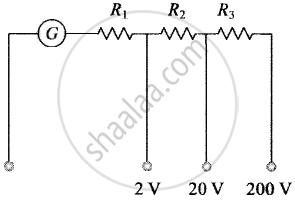
Applying expression in different situations
For `i_G (G + R_1)` = 2 for 2 V range
For `i_G (G + R_1 + R_2)` = 20 for 20 V range
And For `i_G (G + R_1 + R_2 + R_3)` = 200 for 200 V range
By solving, we get
R1 = 1990 Ω R2 = 18 kΩ and R3 = 180 kΩ.
APPEARS IN
RELATED QUESTIONS
The combined resistance of a galvanometer of resistance 500Ω and its shunt is 21Ω. Calculate the value of shunt.
A rectangular coil of a moving coil galvanometer contains 50 turns each having area 12 cm2 . It is suspended in radial magnetic field 0.025 Wb/m2 by a fibre of twist constant 15 x10-10 Nm/degree. Calculate the sensitivity of the moving coil galvanometer.
Obtain the expression for current sensitivity of moving coil galvanometer.
Draw a labelled diagram of a moving coil galvanometer and explain its working. What is the function of radial magnetic field inside the coil?
Explain the significance of a radial magnetic field when a current-carrying coil is kept in it.
Define the term ‘current sensitivity’ of a moving coil galvanometer.
A galvanometer coil has a resistance of 12 Ω and the metre shows full scale deflection for a current of 3 mA. How will you convert the metre into a voltmeter of range 0 to 18 V?
A galvanometer coil has a resistance of 15 Ω and the metre shows full scale deflection for a current of 4 mA. How will you convert the metre into an ammeter of range 0 to 6 A?
The AC voltage across a resistance can be measured using a ______.
The deflection in a moving coil galvanometer is ______.
Assertion (A): On Increasing the current sensitivity of a galvanometer by increasing the number of turns may not necessarily increase its voltage sensitivity.
Reason (R): The resistance of the coil of the galvanometer increases on increasing the number of turns.
Select the most appropriate answer from the options given below:
The coil of galvanometer consists of 100 turns and effective area of 1 square cm. The restoring couple is 10-8 N-m/rad. The magnetic field between the pole pieces is 5T. The current sensitivity of this galvanometer will be ______.
When a galvanometer is shunted with a 4 Ω resistance, the deflection is reduced to one-fifth. If the galvanometer is further shunted with a 2 Ω wire. The further reduction (find the ratio of decrease in current to the previous current) in the deflection will be (the main current remains the same)
A galvanometer coil bas 500 turns and each tum has an average area of 3 × 10⁻⁴ m2. If a torque of 1.5 Nm is required to keep this coil parallel to a magnetic field when a current of 0.5 A is flowing through it, the strength of the field (in T) is ______.
A galvanometer having a resistance of 20 Ω and 30 Ω division on both sides has figure of merit 0.005 ampere/division. The resistance that should be connected in series such that it can be used as a voltmeter upto 15 volt, is ______.
A resistance of 3Ω is connected in parallel to a galvanometer of resistance 297Ω. Find the fraction of current passing through the galvanometer.
To convert a moving coil galvanometer into an ammeter we need to connect a ______.
The figure below shows a circuit containing an ammeter A, a galvanometer G and a plug key K. When the key is closed:

