Advertisements
Advertisements
प्रश्न
A multirange voltmeter can be constructed by using a galvanometer circuit as shown in figure. We want to construct a voltmeter that can measure 2V, 20V and 200V using a galvanometer of resistance 10Ω and that produces maximum deflection for current of 1 mA. Find R1, R2 and R3 that have to be used.

Advertisements
उत्तर
The galvanometer can also be used as a voltmeter to measure the voltage across a given section of the circuit. For this, a very high resistance wire is to be connected in series with galvanometer. The relationship is given by Ig (G + R) – V where Ig is the range of galvanometer, G is the resistance of galvanometer and R is the resistance of wire connected in series with galvanometer.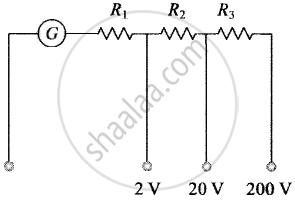
Applying expression in different situations
For `i_G (G + R_1)` = 2 for 2 V range
For `i_G (G + R_1 + R_2)` = 20 for 20 V range
And For `i_G (G + R_1 + R_2 + R_3)` = 200 for 200 V range
By solving, we get
R1 = 1990 Ω R2 = 18 kΩ and R3 = 180 kΩ.
APPEARS IN
संबंधित प्रश्न
The combined resistance of a galvanometer of resistance 500Ω and its shunt is 21Ω. Calculate the value of shunt.
A galvanometer of resistance G is converted into a voltmeter to measure upto V volts by connecting a resistance R1 in series with the coil. If a resistance R2 is connected in series with it, then it can measures upto V/2 volts. Find the resistance, in terms of R1 and R2, required to be connected to convert it into a voltmeter that can read upto 2 V. Also find the resistance G of the galvanometer in terms of R1 and R2
Increasing the current sensitivity of a galvanometer may not necessarily increase its voltage sensitivity. Explain, giving reason.
Two moving coil meters, M1 and M2 have the following particulars:
R1 = 10 Ω, N1 = 30,
A1 = 3.6 × 10⁻³ m2, B1 = 0.25 T
R2 = 14 Ω, N2 = 42,
A2 = 1.8 × 10⁻³ m2, B2 = 0.50 T
(The spring constants are identical for the two meters.)
Determine the ratio of
- current sensitivity and
- voltage sensitivity of M2 and M1.
The fraction of the total current passing through the galvanometer is ............ .
a) `S/(S+G)`
b) `G/(S+G)`
c) `(S+G)/G`
d) `(S+G)/S`
Why is it necessary to introduce a radial magnetic field inside the coil of a galvanometer?
State the principle of the working of a moving coil galvanometer, giving its labeled diagram ?
A moving coil galvanometer has a coil of resistance 59 Ω. It shows a full-scale deflection for a current of 50 mA. How will you convert it to an ammeter having a range of 0 to 3A?
The current sensitivity of a galvanometer increase by 20%. If its resistance also increases by 25%, the voltage sensitivity will ______.
In an ammeter 0.5% of main current passes through galvanometer; If resistance of galvanometer is G, the resistance of ammeter will be.
The voltage sensitivity of a moving coil galvanometer, where G is the resistance of the galvanometer coil, is given by:
Between two galvanometers, the one with the smaller figure of merit is:
The use of a radial magnetic field, in which \(\sin\theta = 1\) at all positions, produces a galvanometer scale deflection that is:
At equilibrium, the deflecting and restoring torques acting on the coil of a moving coil galvanometer satisfy the condition:
The poles of the permanent magnet used in a moving coil galvanometer are shaped as:
In a suspended-coil galvanometer, the phosphor-bronze strip serves to:
In a circuit with a 3 V source and a 3 Ω resistor, the galvanometer \((R_G = 60\ \Omega)\) is converted into an ammeter using a shunt resistance \(r_s = 0.02\ \Omega\). The measured current is approximately:
