Advertisements
Advertisements
प्रश्न
Outline the necessary steps to convert a galvanometer of resistance RG into an ammeter of a given range ?
Advertisements
उत्तर
Conversion of a galvanometer to ammeter
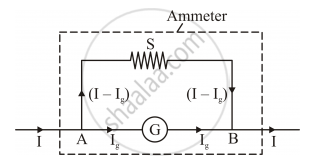
• A shunt (low resistance) is connected in parallel with the galvanometer.
`S = ((I_g)/(I -I_g))G`
Where,
I → Total current in circuit
G → Resistance of the galvanometer
S →Resistance of the shunt
Ig → Current through galvanometer
APPEARS IN
संबंधित प्रश्न
Why does a galvanometer show a momentary deflection at the time of charging or discharging a capacitor? Write the necessary expression to explain this observation.
- A circular coil of 30 turns and radius 8.0 cm carrying a current of 6.0 A is suspended vertically in a uniform horizontal magnetic field of magnitude 1.0 T. The field lines make an angle of 60° with the normal of the coil. Calculate the magnitude of the counter torque that must be applied to prevent the coil from turning.
- Would your answer change, if the circular coil in (a) were replaced by a planar coil of some irregular shape that encloses the same area? (All other particulars are also unaltered.)
Why is it necessary to introduce a radial magnetic field inside the coil of a galvanometer?
Can a galvanometer as such be used for measuring the current? Explain.
Why does a galvanometer when connected in series with a capacitor show a momentary deflection, when it is being charged or discharged?
How does this observation lead to modifying the Ampere's circuital law?
Hence write the generalised expression of Ampere's law.
Explain, giving reasons, the basic difference in converting a galvanometer into (i) a voltmeter and (ii) an ammeter?
A galvanometer coil has a resistance of 15 Ω and the metre shows full scale deflection for a current of 4 mA. How will you convert the metre into an ammeter of range 0 to 6 A?
A moving coil galvanometer of resistance 55 Ω produces a full scale deflection for a current of 250 mA. How will you convert it into an ammeter with a range of 0 - 3A?
The voltage sensitivity of a moving coil galvanometer, where G is the resistance of the galvanometer coil, is given by:
The poles of the permanent magnet used in a moving coil galvanometer are shaped as:
