Advertisements
Advertisements
प्रश्न
A moving coil galvanometer has a coil of resistance 59 Ω. It shows a full-scale deflection for a current of 50 mA. How will you convert it to an ammeter having a range of 0 to 3A?
Advertisements
उत्तर
Let resistance of R, Ω be shunted with galvanometer to make it an ammeter in parallel.
p.d. across the galvanometer = p.d. across the shunt
IC1 x RC1 =(I- lC1 ) . RS
⇒ `R_s = (I_(C_1)R_(C_1))/(I-I_(C_1))=(50xx10^-3 xx59)/((3-50xx10^-3))`
⇒ `R_s = (50xx10^-3 xx59)/2.95 = (50xx10^-3 xx10^2 xx59)/295`
∴ `R_s = 1 Omega `
A resistance of 1 Ω be required to shunt in order to comvert this into ammeter.
APPEARS IN
संबंधित प्रश्न
An ideal voltmeter has _______.
(A) low resistance
(b) high resistance
(C) infinite resistance
(D) zero resistance
Define current sensitivity of a galvanometer.
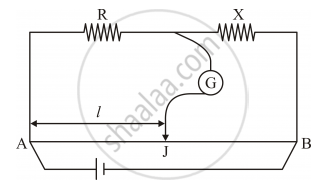
In the meter bridge experiment, balance point was observed at J with AJ = l.
(i) The values of R and X were doubled and then interchanged. What would be the new position of balance point?
(ii) If the galvanometer and battery are interchanged at the balance position, how will the alance point get affected?
Outline the necessary steps to convert a galvanometer of resistance RG into an ammeter of a given range ?
Why are the pole pieces of a horseshoe magnet in a moving coil galvanometer made cylinder in shape?
In an ammeter 0.5% of main current passes through galvanometer; If resistance of galvanometer is G, the resistance of ammeter will be.
How is current sensitivity increased?
Explain in brief the basic construction of a moving-coil table galvanometer whit a neat labelled diagram.
A sensitive electromagnetic instrument used to detect and measure small electric currents (of the order of microamperes to milliamperes) by measuring the deflection of a current-carrying coil placed in a uniform magnetic field is called a:
The use of a radial magnetic field, in which \(\sin\theta = 1\) at all positions, produces a galvanometer scale deflection that is:
