Advertisements
Advertisements
प्रश्न
State the principle of the working of a moving coil galvanometer, giving its labeled diagram ?
Advertisements
उत्तर
Moving coil Galvanometer
Principle:
Its working is based on the fact that when a current carrying coil is placed in a magnetic field, it experiences a torque.

Working:
Suppose the coil PQRS is suspended freely in the magnetic field.
Let
l = Length PQ or RS of the coil
b = Breadth QR or SP of the coil
n = Number of turns in the coil
Area of each turn of the coil, A = l × b
Let B = Strength of the magnetic field in which coil is suspended
I = Current passing through the coil in the direction PQRS
Let, at any instant, α be the angle which the normal drawn on the plane of the coil makes with the direction of magnetic field.
The rectangular coil carrying current when placed in the magnetic field experiences a torque whose magnitude is given by,
τ = nIBA sin α
APPEARS IN
संबंधित प्रश्न
The combined resistance of a galvanometer of resistance 500Ω and its shunt is 21Ω. Calculate the value of shunt.
How will you convert a moving coil galvanometer into a voltmeter?
Define the current sensitivity of a galvanometer ?
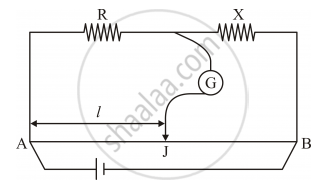
In the meter bridge experiment, balance point was observed at J with AJ = l.
(i) The values of R and X were doubled and then interchanged. What would be the new position of balance point?
(ii) If the galvanometer and battery are interchanged at the balance position, how will the alance point get affected?
What are the advantages of using soft iron as a core, instead of steel, in the coils of galvanometers?
A moving coil galvanometer has a coil of resistance 59 Ω. It shows a full-scale deflection for a current of 50 mA. How will you convert it to an ammeter having a range of 0 to 3A?
The current sensitivity of a galvanometer increase by 20%. If its resistance also increases by 25%, the voltage sensitivity will ______.
The coil of galvanometer consists of 100 turns and effective area of 1 square cm. The restoring couple is 10-8 N-m/rad. The magnetic field between the pole pieces is 5T. The current sensitivity of this galvanometer will be ______.
A multirange current meter can be constructed by using a galvanometer circuit as shown in figure. We want a current meter that can measure 10 mA, 100 mA and 1A using a galvanometer of resistance 10 Ω and that prduces maximum deflection for current of 1mA. Find S1, S2 and S3 that have to be used

