Advertisements
Advertisements
प्रश्न
A multirange current meter can be constructed by using a galvanometer circuit as shown in figure. We want a current meter that can measure 10 mA, 100 mA and 1A using a galvanometer of resistance 10 Ω and that prduces maximum deflection for current of 1mA. Find S1, S2 and S3 that have to be used

Advertisements
उत्तर
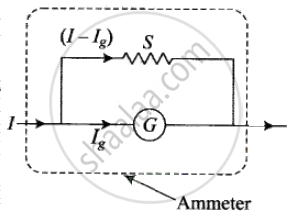
A galvanometer can be converted into ammeter by connecting a very low resistance wire (shunt S) connected in parallel with galvanometer. The relationship is given by IgG = (I – Ig) S, where Ig is the range of galvanometer and G is the resistance of galvanometer.
For measuring `I_1 = 10 mA: I_G.G = (I_1 - I_G)(S_1 + S_2 + S_3)`
For measuring `I_2 = 100 mA: I_G(G + S_1) = (I_2 - I_G)(S_2 + S_3)`
For measuring `I_3 = 1 A: I_G(G + S_1 + S_2) = (I_3 - I_G)(S_3)`
Gives `S_1 = 1 Ω, S_2 = 0.1 Ω`
And `S_3 = 0.01 Ω`
APPEARS IN
संबंधित प्रश्न
Write the underlying principle of a moving coil galvanometer.
Why does a galvanometer show a momentary deflection at the time of charging or discharging a capacitor? Write the necessary expression to explain this observation.
Draw a labelled diagram of a moving coil galvanometer. Describe briefly its principle and working.
Increasing the current sensitivity of a galvanometer may not necessarily increase its voltage sensitivity. Explain, giving reason.
Two moving coil meters, M1 and M2 have the following particulars:
R1 = 10 Ω, N1 = 30,
A1 = 3.6 × 10⁻³ m2, B1 = 0.25 T
R2 = 14 Ω, N2 = 42,
A2 = 1.8 × 10⁻³ m2, B2 = 0.50 T
(The spring constants are identical for the two meters.)
Determine the ratio of
- current sensitivity and
- voltage sensitivity of M2 and M1.
A moving coil galvanometer has a resistance of 25Ω and gives a full scale deflection for a current of 10mA. How will you convert it into a voltmeter having range 0 - 100 V?
A galvanometer has a resistance of 16Ω. It shows full scale deflection, when a current of 20 mA is passed through it. The only shunt resistance available is 0.06 which is not appropriate to convert a galvanometer into an ammeter. How much resistance should be connected in series with the coil of galvanometer, so that the range of ammeter is 8 A?
Can a galvanometer as such be used for measuring the current? Explain.
Define current sensitivity of a galvanometer.
Write current sensitivity of a galvanomete S.I. unit.
Outline the necessary steps to convert a galvanometer of resistance RG into an ammeter of a given range ?
Define the term ‘current sensitivity’ of a moving coil galvanometer.
The deflection in a moving coil galvanometer is ______.
A moving coil galvanometer can be converted into an ammeter by ______.
A resistance of 3Ω is connected in parallel to a galvanometer of resistance 297Ω. Find the fraction of current passing through the galvanometer.
A moving coil galvanometer of resistance 55 Ω produces a full scale deflection for a current of 250 mA. How will you convert it into an ammeter with a range of 0 - 3A?
The figure below shows a circuit containing an ammeter A, a galvanometer G and a plug key K. When the key is closed:

The figure of merit of a galvanometer is:
At equilibrium, the deflecting and restoring torques acting on the coil of a moving coil galvanometer satisfy the condition:
