Advertisements
Advertisements
प्रश्न
Explain how moving coil galvanometer is converted into a voltmeter. Derive the necessary formula.
Advertisements
उत्तर
a. To use a M.C.G as a voltmeter, its resistance should be increased to a desired value and
an arrangement should be provided to measure large potential difference. This is
achieved by connecting a high resistance in series with the M.C.G.
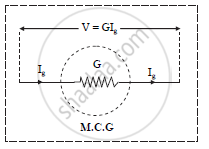
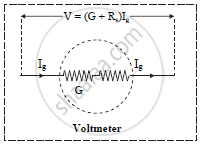
b. Let ‘G’ be the resistance of the galvanometer coil and ‘Ig’ be the maximum current
which can be passed through the galvanometer coil for full-scale deflection.
c. Let ‘V’ be the potential difference to be measured.
Let ‘Rs’ be the resistance connected in series with the galvanometer coil.
d. From Ohm’s law,
V = Ig (G + Rs)
G + Rs=`V/I_g`
Rs=`V/I_g-G`
Knowing V, Ig and G, value of Rs can be determined.
APPEARS IN
संबंधित प्रश्न
The combined resistance of a galvanometer of resistance 500Ω and its shunt is 21Ω. Calculate the value of shunt.
The combined resistance of a galvanometer of resistance 500Ω and its shunt is 21Ω. Calculate the value of shunt.
A rectangular coil of a moving coil galvanometer contains 50 turns each having area 12 cm2 . It is suspended in radial magnetic field 0.025 Wb/m2 by a fibre of twist constant 15 x10-10 Nm/degree. Calculate the sensitivity of the moving coil galvanometer.
Show that the current flowing through a moving coil galvanometer is directly proportional to the angle of deflection of coil.
Write the underlying principle of a moving coil galvanometer.
Obtain the expression for current sensitivity of moving coil galvanometer.
A circular coil of 250 turns and diameter 18 cm carries a current of 12A. What is the magnitude of magnetic moment associated with the coil?
A galvanometer of resistance G is converted into a voltmeter to measure upto V volts by connecting a resistance R1 in series with the coil. If a resistance R2 is connected in series with it, then it can measures upto V/2 volts. Find the resistance, in terms of R1 and R2, required to be connected to convert it into a voltmeter that can read upto 2 V. Also find the resistance G of the galvanometer in terms of R1 and R2
Increasing the current sensitivity of a galvanometer may not necessarily increase its voltage sensitivity. Explain, giving reason.
- A circular coil of 30 turns and radius 8.0 cm carrying a current of 6.0 A is suspended vertically in a uniform horizontal magnetic field of magnitude 1.0 T. The field lines make an angle of 60° with the normal of the coil. Calculate the magnitude of the counter torque that must be applied to prevent the coil from turning.
- Would your answer change, if the circular coil in (a) were replaced by a planar coil of some irregular shape that encloses the same area? (All other particulars are also unaltered.)
A galvanometer has a resistance of 16Ω. It shows full scale deflection, when a current of 20 mA is passed through it. The only shunt resistance available is 0.06 which is not appropriate to convert a galvanometer into an ammeter. How much resistance should be connected in series with the coil of galvanometer, so that the range of ammeter is 8 A?
Define the current sensitivity of a galvanometer ?
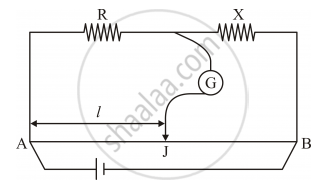
In the meter bridge experiment, balance point was observed at J with AJ = l.
(i) The values of R and X were doubled and then interchanged. What would be the new position of balance point?
(ii) If the galvanometer and battery are interchanged at the balance position, how will the alance point get affected?
State the underlying principle of working of a moving coil galvanometer. Write two reasons why a galvanometer can not be used as such to measure current in a given circuit. Name any two factors on which the current sensitivity of a galvanometer depends.
Why are the pole pieces of a horseshoe magnet in a moving coil galvanometer made cylinder in shape?
State how a moving coil galvanometer can be converted into an ammeter.
Explain the significance of a radial magnetic field when a current-carrying coil is kept in it.
The deflection in a moving coil galvanometer is ______.
In a moving coil galvanometer the deflection (Φ) on the scale by a pointer attached to the spring is ______.
The conversion of a moving coil galvanometer into a voltmeter is done by ______.
Assertion (A): On Increasing the current sensitivity of a galvanometer by increasing the number of turns may not necessarily increase its voltage sensitivity.
Reason (R): The resistance of the coil of the galvanometer increases on increasing the number of turns.
Select the most appropriate answer from the options given below:
In an ammeter 0.5% of main current passes through galvanometer; If resistance of galvanometer is G, the resistance of ammeter will be.
The coil of galvanometer consists of 100 turns and effective area of 1 square cm. The restoring couple is 10-8 N-m/rad. The magnetic field between the pole pieces is 5T. The current sensitivity of this galvanometer will be ______.
A multirange current meter can be constructed by using a galvanometer circuit as shown in figure. We want a current meter that can measure 10 mA, 100 mA and 1A using a galvanometer of resistance 10 Ω and that prduces maximum deflection for current of 1mA. Find S1, S2 and S3 that have to be used

A galvanometer having a resistance of 20 Ω and 30 Ω division on both sides has figure of merit 0.005 ampere/division. The resistance that should be connected in series such that it can be used as a voltmeter upto 15 volt, is ______.
A galvanometer shows full-scale deflection for current Ig. A resistance R1 is required to convert it into a voltmeter of range (0 - V) and a resistance R2 to convert it into a voltmeter of range (0 - 2V). Find the resistance of the galvanometer.
How is current sensitivity increased?
Explain in brief the basic construction of a moving-coil table galvanometer whit a neat labelled diagram.
A resistance of 3Ω is connected in parallel to a galvanometer of resistance 297Ω. Find the fraction of current passing through the galvanometer.
A voltmeter has a range of 0 - 20 V and a resistance of 500 Q. Explain how can be used to measure voltages from 0 - 200 volt?
To convert a moving coil galvanometer into an ammeter we need to connect a ______.
The figure below shows a circuit containing an ammeter A, a galvanometer G and a plug key K. When the key is closed:

A sensitive electromagnetic instrument used to detect and measure small electric currents (of the order of microamperes to milliamperes) by measuring the deflection of a current-carrying coil placed in a uniform magnetic field is called a:
Voltage sensitivity of a galvanometer is defined as the:
The figure of merit of a galvanometer is:
The current sensitivity of a moving coil galvanometer is given by:
The unit in which the current sensitivity of a galvanometer is expressed is:
The voltage sensitivity of a moving coil galvanometer, where G is the resistance of the galvanometer coil, is given by:
The unit of voltage sensitivity of a galvanometer is:
The figure of merit k of a galvanometer is given by:
The use of a radial magnetic field, in which \(\sin\theta = 1\) at all positions, produces a galvanometer scale deflection that is:
At equilibrium, the deflecting and restoring torques acting on the coil of a moving coil galvanometer satisfy the condition:
In a suspended-coil galvanometer, the phosphor-bronze strip serves to:
In the pivoted-coil (Weston) type galvanometer, the two hair springs:
The non-magnetic frame of a moving coil galvanometer is made of aluminium, and its function is to provide:
An ammeter, ideally, has:
A voltmeter is connected across a component:
A circuit consists of a 3 V source and a 3 Ω resistor. With an ideal ammeter of zero resistance inserted, the current in the circuit is:
