Advertisements
Advertisements
प्रश्न
Figure below shows two resistors R1 and R2 connected to a battery having an emf of 40V and negligible internal resistance. A voltmeter having a resistance of. 300 Ω is used to measure the potential difference across R1 Find the reading of the voltmeter.

Advertisements
उत्तर
R1 and R3 are in parallel.
∴ Current I in the circuit remains unchanged in R1 and R3 combination and R2
`1/(R') = 1/200 +1/300 =5/600`
`R' = 600/5 = 120 Omega `
∴ REquivalent in circuit = 120 + 880 = 1000 Ω
I, current.in the circuit =`40/1000 A`
∴ V =` 40/1000 xx 120`
⇒ `V = 48/10`
∴ V = 4.8 V
APPEARS IN
संबंधित प्रश्न
In the given circuit in the steady state, obtain the expressions for (a) the potential drop (b) the charge and (c) the energy stored in the capacitor, C.

Write two possible causes for one sided deflection in a potentiometer experiment.
Describe briefly, with the help of a circuit diagram, how a potentiometer is used to determine the internal resistance of a cell.
When the null point is obtained in the potentiometer, the current is drawn from the ______
The emf of a standard cell is 1.5V and is balanced by a length of 300 cm of a potentiometer with a 10 m long wire. Find the percentage error in a voltmeter that balances at 350 cm when its reading is 1.8 V.
In the experiment to determine the internal resistance of a cell (E1) using a potentiometer, the resistance drawn from the resistance box is 'R'. The potential difference across the balancing length of the wire is equal to the terminal potential difference (V) of the cell. The value of internal resistance (r) of the cell is ______
In a potentiometer of 10 wires, the balance point is obtained on the 7th wire. To shift the balance point to 9th wire, we should ______.
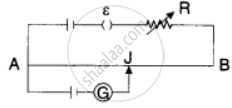
AB is a wire of potentiometer with the increase in the value of resistance R, the shift in the balance point J will be ______.
A wire of resistance R is cut into two equal part. There parts are then connected in parallel. The equivalent resistance of the combination will be
What should be the diameter of a soap bubble such that the excess pressure inside it is 51.2 Pa? [Surface tension of soap solution = 3.2 × 10⁻² N/m]
