Advertisements
Advertisements
Question
Figure below shows two resistors R1 and R2 connected to a battery having an emf of 40V and negligible internal resistance. A voltmeter having a resistance of. 300 Ω is used to measure the potential difference across R1 Find the reading of the voltmeter.

Advertisements
Solution
R1 and R3 are in parallel.
∴ Current I in the circuit remains unchanged in R1 and R3 combination and R2
`1/(R') = 1/200 +1/300 =5/600`
`R' = 600/5 = 120 Omega `
∴ REquivalent in circuit = 120 + 880 = 1000 Ω
I, current.in the circuit =`40/1000 A`
∴ V =` 40/1000 xx 120`
⇒ `V = 48/10`
∴ V = 4.8 V
APPEARS IN
RELATED QUESTIONS
State the underlying principle of a potentiometer ?
The potentiometer wire AB shown in the figure is 50 cm long. When AD = 30 cm, no deflection occurs in the galvanometer. Find R.
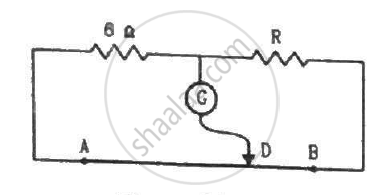
The resistance of a potentiometer wire is 8 Ω and its length is 8 m. A resistance box and a 2 V battery are connected in series with iL What should be the resistance in the box if it is desired to have a potential drop of 1 µV/mm?
If the e.m.f of a cell is not constant in the metre bridge experiment, then the ____________.
A 10 m long wire of uniform cross-section and 20 Ω resistance is used in a potentiometer. The wire is connected in series with a battery of 5 V along with an external resistance of 480 Ω. If an unknown emf E is balanced at 6.0 m length of the wire, then the value of unknown emf is ______.

The conductivity of super - conductor is
AB is a potentiometer wire (Figure). If the value of R is increased, in which direction will the balance point J shift?

For the circuit shown, with R1 = 1.0 Ω, R2 = 2.0 Ω, E1 = 2 V, and E2 = E3 = 4 V, the potential difference between the points 'a' and 'b' is approximately (in V) ______.

Draw neat labelled diagram of potentiometer as voltage divider.
