Advertisements
Advertisements
प्रश्न
Can a galvanometer as such be used for measuring the current? Explain.
Advertisements
उत्तर
Yes a galvanometer can be used for measuring the current
Conversion of a galvanometer into an ammeter
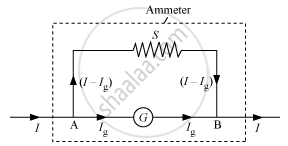
A shunt (low resistance) is connected in parallel with a galvanometer.
`S=(I_g/(I-I_g))G`
Here,
I = total current in circuit
G = resistance of the galvanometer
S = resistance of the shunt
Ig = current through the galvanometer
संबंधित प्रश्न
The combined resistance of a galvanometer of resistance 500Ω and its shunt is 21Ω. Calculate the value of shunt.
The combined resistance of a galvanometer of resistance 500Ω and its shunt is 21Ω. Calculate the value of shunt.
Explain how moving coil galvanometer is converted into a voltmeter. Derive the necessary formula.
Why is it necessary to introduce a radial magnetic field inside the coil of a galvanometer?
Explain, giving reasons, the basic difference in converting a galvanometer into (i) a voltmeter and (ii) an ammeter?
Draw a labelled diagram of a moving coil galvanometer and explain its working. What is the function of radial magnetic field inside the coil?
A galvanometer coil has a resistance of 15 Ω and the metre shows full scale deflection for a current of 4 mA. How will you convert the metre into an ammeter of range 0 to 6 A?
A multirange current meter can be constructed by using a galvanometer circuit as shown in figure. We want a current meter that can measure 10 mA, 100 mA and 1A using a galvanometer of resistance 10 Ω and that prduces maximum deflection for current of 1mA. Find S1, S2 and S3 that have to be used

The equilibrium condition \(NIAB = C\phi\) leads to the current–deflection relationship:
