Advertisements
Advertisements
प्रश्न
Can a galvanometer as such be used for measuring the current? Explain.
Advertisements
उत्तर
Yes a galvanometer can be used for measuring the current
Conversion of a galvanometer into an ammeter
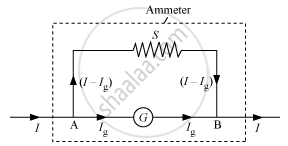
A shunt (low resistance) is connected in parallel with a galvanometer.
`S=(I_g/(I-I_g))G`
Here,
I = total current in circuit
G = resistance of the galvanometer
S = resistance of the shunt
Ig = current through the galvanometer
संबंधित प्रश्न
Obtain the expression for current sensitivity of moving coil galvanometer.
A circular coil of 250 turns and diameter 18 cm carries a current of 12A. What is the magnitude of magnetic moment associated with the coil?
A galvanometer of resistance G is converted into a voltmeter to measure upto V volts by connecting a resistance R1 in series with the coil. If a resistance R2 is connected in series with it, then it can measures upto V/2 volts. Find the resistance, in terms of R1 and R2, required to be connected to convert it into a voltmeter that can read upto 2 V. Also find the resistance G of the galvanometer in terms of R1 and R2
Two moving coil meters, M1 and M2 have the following particulars:
R1 = 10 Ω, N1 = 30,
A1 = 3.6 × 10⁻³ m2, B1 = 0.25 T
R2 = 14 Ω, N2 = 42,
A2 = 1.8 × 10⁻³ m2, B2 = 0.50 T
(The spring constants are identical for the two meters.)
Determine the ratio of
- current sensitivity and
- voltage sensitivity of M2 and M1.
Why is it necessary to introduce a radial magnetic field inside the coil of a galvanometer?
With the help of a neat and labelled diagram, explain the principle and working of a moving coil galvanometer ?
State the principle of the working of a moving coil galvanometer, giving its labeled diagram ?
Explain the significance of a radial magnetic field when a current-carrying coil is kept in it.
When a galvanometer is shunted with a 4 Ω resistance, the deflection is reduced to one-fifth. If the galvanometer is further shunted with a 2 Ω wire. The further reduction (find the ratio of decrease in current to the previous current) in the deflection will be (the main current remains the same)
A moving coil galvanometer has 150 equal divisions. Its current sensitivity is 10-divisions per milliampere and voltage sensitivity is 2 divisions per millivolt. In order that each division reads 1 volt, the resistance in ohms needed to be connected in series with the coil will be ______.
