Advertisements
Advertisements
Question
A galvanometer of resistance 100 Ω gives a full-scale deflection for a potential difference of 200 mV.
- What must be the resistance connected to convert the galvanometer into an ammeter of the range 0-200 mA?
- Determine resistance of the ammeter.
Advertisements
Solution
(i) Given: G = 100 Ω; I = 200 mA;
Vg = 200 mV;
Resistance to be connected to the galvanometer to convert to an ammeter:
S = `("I"_"g""G")/(("I"-"I"_"g"))`
Here Ig= `("V"_"g")/"G"`
= `(200 " mV")/(100 " Ω")`
= 2 mA
S = `(2 × 10^(-3) × 100)/((0.2-0.002))`
S = 1.01 Ω
(ii) `1/"R" = 1/100 + 1/1.01`
R = 0.999 Ω
APPEARS IN
RELATED QUESTIONS
Write the underlying principle of a moving coil galvanometer.
Increasing the current sensitivity of a galvanometer may not necessarily increase its voltage sensitivity. Explain, giving reason.
Why is it necessary to introduce a radial magnetic field inside the coil of a galvanometer?
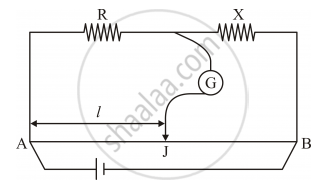
In the meter bridge experiment, balance point was observed at J with AJ = l.
(i) The values of R and X were doubled and then interchanged. What would be the new position of balance point?
(ii) If the galvanometer and battery are interchanged at the balance position, how will the alance point get affected?
State the principle of the working of a moving coil galvanometer, giving its labeled diagram ?
A galvanometer coil has a resistance of 15 Ω and the metre shows full scale deflection for a current of 4 mA. How will you convert the metre into an ammeter of range 0 to 6 A?
A moving coil galvanometer has 150 equal divisions. Its current sensitivity is 10-divisions per milliampere and voltage sensitivity is 2 divisions per millivolt. In order that each division reads 1 volt, the resistance in ohms needed to be connected in series with the coil will be ______.
To convert a moving coil galvanometer into an ammeter we need to connect a ______.
The poles of the permanent magnet used in a moving coil galvanometer are shaped as:
