Advertisements
Advertisements
प्रश्न
Why does a galvanometer when connected in series with a capacitor show a momentary deflection, when it is being charged or discharged?
How does this observation lead to modifying the Ampere's circuital law?
Hence write the generalised expression of Ampere's law.
Advertisements
उत्तर
During charging and discharging of the capacitor, there is a flow of charge from the battery towards the plates of the capacitor, which produces a conduction current in the circuit. Hence, the galvanometer present in the circuit shows momentary deflection.
As the charge on the capacitor grows, the conduction current in the wires increases. When the capacitor is fully charged, the conduction current stops flowing in the wires. During charging or discharging of the capacitor, there is no conduction current between the plates of capacitor, as they are not connected by any conduction material. Therefore, in this region, a current must exist that makes the total current in the circuit continuous. This observation leads to modifying the Ampere's circuital law.
Thus, there must be displacement current along with the conduction current in the circuit having the property of continuity, although individually they may not be continuous.
Maxwell modified Ampere's circuital law in order to make it logically consistent. He stated Ampere's circuital law in the form,
This is the generalised expression of Ampere's law.
APPEARS IN
संबंधित प्रश्न
Show that the current flowing through a moving coil galvanometer is directly proportional to the angle of deflection of coil.
Explain how moving coil galvanometer is converted into a voltmeter. Derive the necessary formula.
With the help of a neat and labelled diagram, explain the principle and working of a moving coil galvanometer ?
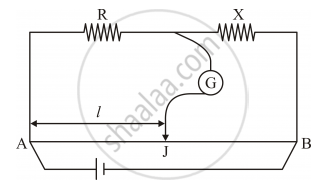
In the meter bridge experiment, balance point was observed at J with AJ = l.
(i) The values of R and X were doubled and then interchanged. What would be the new position of balance point?
(ii) If the galvanometer and battery are interchanged at the balance position, how will the alance point get affected?
Explain the significance of a radial magnetic field when a current-carrying coil is kept in it.
A resistance of 3Ω is connected in parallel to a galvanometer of resistance 297Ω. Find the fraction of current passing through the galvanometer.
Current sensitivity of a galvanometer is defined as the:
The figure of merit k of a galvanometer is given by:
In a circuit with a 3 V source and a 3 Ω resistor, the galvanometer \((R_G = 60\ \Omega)\) is converted into an ammeter using a shunt resistance \(r_s = 0.02\ \Omega\). The measured current is approximately:
