Advertisements
Advertisements
प्रश्न
Using Ampere’s circuital law, obtain the expression for the magnetic field due to a long solenoid at a point inside the solenoid on its axis ?
Advertisements
उत्तर
Solenoid
• It consists of an insulating long wire closely wound in the form of helix.
• Its length is large as compared to its diameter.
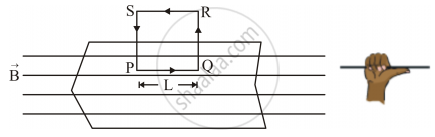
• Magnetic field due to RQ and SP path is zero because they are perpendicular to the axis of solenoid. Since SR is outside the solenoid, the magnetic field is zero.
• The line integral of magnetic field induction `vecB` over the closed path PQRS is
`oint_(PQRS) vecB*vecdl =oint_(PQ)vecB*vecdl =BL`
From Ampere’s circuital law,
`oint_(PQRS)vecB*vecdl = mu_0 `× Total current through rectangle PQRS
BL = μ0 × Number of turns in rectangle × Current
BL = μ0nLI
∴ B= μ0nI
APPEARS IN
संबंधित प्रश्न
Write Maxwell's generalization of Ampere's circuital law. Show that in the process of charging a capacitor, the current produced within the plates of the capacitor is `I=varepsilon_0 (dphi_E)/dt,`where ΦE is the electric flux produced during charging of the capacitor plates.
A long straight wire of a circular cross-section of radius ‘a’ carries a steady current ‘I’. The current is uniformly distributed across the cross-section. Apply Ampere’s circuital law to calculate the magnetic field at a point ‘r’ in the region for (i) r < a and (ii) r > a.
A long, cylindrical wire of radius b carries a current i distributed uniformly over its cross section. Find the magnitude of the magnetic field at a point inside the wire at a distance a from the axis.
Two identical current carrying coaxial loops, carry current I in opposite sense. A simple amperian loop passes through both of them once. Calling the loop as C, then which statement is correct?
Ampere's circuital law is used to find out ______
A thick current carrying cable of radius ‘R’ carries current ‘I’ uniformly distributed across its cross-section. The variation of magnetic field B(r) due to the cable with the distance ‘r’ from the axis of the cable is represented by:
Which law provides a simpler alternative method for finding the magnetic field \[B\] when the current distribution has symmetry (straight wire, solenoid, toroid)?
Substituting \[B=\frac{\mu_0 I}{2\pi r}\] into \[\oint\vec{B}\cdot d\vec{l}=B(2\pi r)\] for a straight wire yields:
According to the right-hand rule sign convention for Ampere's law, currents flowing in the direction of the thumb are taken as ______ and currents flowing opposite to it are taken as ______.
