Advertisements
Advertisements
प्रश्न
Using Ampere's circuital law, obtain an expression for the magnetic flux density 'B' at a point 'X' at a perpendicular distance 'r' from a long current-carrying conductor.
(Statement of the law is not required).
Advertisements
उत्तर
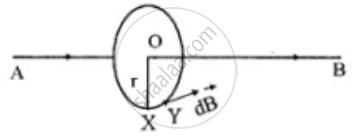
Let AB, a long straight wire is carrying current i. The magnetic flux density `bar(B)` is to be required at point X at a distance r.
Let us draw a circle of radius r with centre O as shown in above figure. The point X lies on the circumference of the circle.
According to Ampere's circuital law,
`oint bar(B). bar(dl)= μ_0i. "where " bar(dl)` = infinitesimally small portion XY in the circle.
For complete circle, `bar(dl)= 2pir`
∴ `bar(B). 2pir = μ_0i`
⇒ `bar (B) = (mu_0)/(2pi).i/r NA^(-1)m^(- 1)`
⇒ `bar (B) = (mu_0)/(4pi).(2i)/r`
∴ `bar (B) = 10^-7 .(2i)/r NA^(-1)m^(- 1)`
APPEARS IN
संबंधित प्रश्न
Electron drift speed is estimated to be of the order of mm s−1. Yet large current of the order of few amperes can be set up in the wire. Explain briefly.
Obtain an expression for magnetic induction along the axis of the toroid.
A long, straight wire carries a current. Is Ampere's law valid for a loop that does not enclose the wire, or that encloses the wire but is not circular?
Two large metal sheets carry currents as shown in figure. The current through a strip of width dl is Kdl where K is a constant. Find the magnetic field at the points P, Q and R.
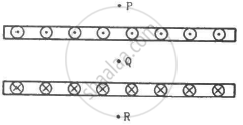
Consider the situation of the previous problem. A particle having charge q and mass mis projected from the point Q in a direction going into the plane of the diagram. It is found to describe a circle of radius r between the two plates. Find the speed of the charged particle.
Two identical current carrying coaxial loops, carry current I in opposite sense. A simple amperian loop passes through both of them once. Calling the loop as C, then which statement is correct?
Read the following paragraph and answer the questions.
|
Consider the experimental set-up shown in the figure. This jumping ring experiment is an outstanding demonstration of some simple laws of Physics. A conducting non-magnetic ring is placed over the vertical core of a solenoid. When current is passed through the solenoid, the ring is thrown off. |

- Explain the reason for the jumping of the ring when the switch is closed in the circuit.
- What will happen if the terminals of the battery are reversed and the switch is closed? Explain.
- Explain the two laws that help us understand this phenomenon.
Ampere's Circuital Law is the magnetic analogue of which law in electrostatics?
Substituting \[B=\frac{\mu_0 I}{2\pi r}\] into \[\oint\vec{B}\cdot d\vec{l}=B(2\pi r)\] for a straight wire yields:
