Advertisements
Advertisements
प्रश्न
Write Maxwell's generalization of Ampere's circuital law. Show that in the process of charging a capacitor, the current produced within the plates of the capacitor is `I=varepsilon_0 (dphi_E)/dt,`where ΦE is the electric flux produced during charging of the capacitor plates.
Advertisements
उत्तर
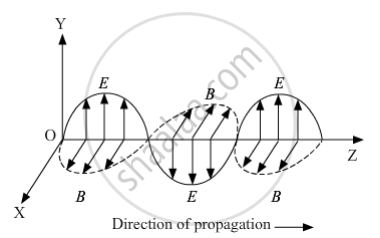
A moving charge produces both electric and magnetic fields, and an oscillating charge produces oscillating magnetic and electric fields. These oscillating electric and magnetic fields with respect to space and time produce electromagnetic waves.
The propagation of electromagnetic waves can be shown as
OR
Maxwell's generalisation of Ampere's circuital law is given as follows:
`oint vec"B".vec"dl"=mu_0(I+I_D)=mu_0(I+varepsilon_0 (dphi)/dt)`
Consider that a parallel capacitor C is charging in a circuit.
The magnitude of electric field between the two plates will be `E=q/(varepsilon_0 A)`and is perpendicular to the surface of the plate.
`phi_E=vecE.vecA=EA cos0=q/(varepsilon_0 A)xxA=q/varepsilon_0`
`=>(dphi_E)/dt=(d(q/varepsilon_0))/dt`
`=>(dq)/dt=varepsilon_0(dphi_E)/dt ("Here, dq/dt is rate of change of charge with time.")`
`=>I=varepsilon_0(dphi_E)/dt`
APPEARS IN
संबंधित प्रश्न
Write Maxwell's generalization of Ampere's circuital law. Show that in the process of charging a capacitor, the current produced within the plates of the capacitor is `I=varepsilon_0 (dphi_E)/dt,`where ΦE is the electric flux produced during charging of the capacitor plates.
Electron drift speed is estimated to be of the order of mm s−1. Yet large current of the order of few amperes can be set up in the wire. Explain briefly.
A thin but long, hollow, cylindrical tube of radius r carries i along its length. Find the magnitude of the magnetic field at a distance r/2 from the surface (a) inside the tube (b) outside the tube.
Two concentric and coplanar circular loops P and Q have their radii in the ratio 2:3. Loop Q carries a current 9 A in the anticlockwise direction. For the magnetic field to be zero at the common centre, loop P must carry ______.
A long straight wire of radius 'a' carries a steady current 'I'. The current is uniformly distributed across its area of cross-section. The ratio of the magnitude of magnetic field `vecB_1` at `a/2` and `vecB_2` at distance 2a is ______.
The given figure shows a long straight wire of a circular cross-section (radius a) carrying steady current I. The current I is uniformly distributed across this cross-section. Calculate the magnetic field in the region r < a and r > a.

Using Ampere’s circuital law, obtain an expression for magnetic flux density ‘B’ at a point near an infinitely long and straight conductor, carrying a current I.
According to Ampere's Circuital Law, the line integral \[\oint\vec{B}\cdot d\vec{l}\] taken around any closed loop equals:
