Advertisements
Advertisements
प्रश्न
Write Maxwell's generalization of Ampere's circuital law. Show that in the process of charging a capacitor, the current produced within the plates of the capacitor is `I=varepsilon_0 (dphi_E)/dt,`where ΦE is the electric flux produced during charging of the capacitor plates.
Advertisements
उत्तर
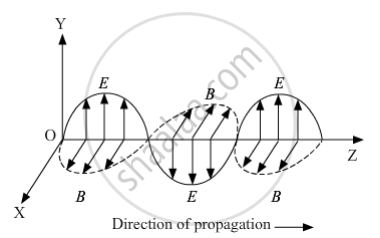
A moving charge produces both electric and magnetic fields, and an oscillating charge produces oscillating magnetic and electric fields. These oscillating electric and magnetic fields with respect to space and time produce electromagnetic waves.
The propagation of electromagnetic waves can be shown as
OR
Maxwell's generalisation of Ampere's circuital law is given as follows:
`oint vec"B".vec"dl"=mu_0(I+I_D)=mu_0(I+varepsilon_0 (dphi)/dt)`
Consider that a parallel capacitor C is charging in a circuit.
The magnitude of electric field between the two plates will be `E=q/(varepsilon_0 A)`and is perpendicular to the surface of the plate.
`phi_E=vecE.vecA=EA cos0=q/(varepsilon_0 A)xxA=q/varepsilon_0`
`=>(dphi_E)/dt=(d(q/varepsilon_0))/dt`
`=>(dq)/dt=varepsilon_0(dphi_E)/dt ("Here, dq/dt is rate of change of charge with time.")`
`=>I=varepsilon_0(dphi_E)/dt`
APPEARS IN
संबंधित प्रश्न
A 3.0 cm wire carrying a current of 10 A is placed inside a solenoid perpendicular to its axis. The magnetic field inside the solenoid is given to be 0.27 T. What is the magnetic force on the wire?
Obtain an expression for magnetic induction along the axis of the toroid.
A hollow tube is carrying an electric current along its length distributed uniformly over its surface. The magnetic field
(a) increases linearly from the axis to the surface
(b) is constant inside the tube
(c) is zero at the axis
(d) is zero just outside the tube.
A thin but long, hollow, cylindrical tube of radius r carries i along its length. Find the magnitude of the magnetic field at a distance r/2 from the surface (a) inside the tube (b) outside the tube.
What is magnetic permeability?
Calculate the magnetic field inside and outside of the long solenoid using Ampere’s circuital law
A solenoid of length 0.6 m has a radius of 2 cm and is made up of 600 turns If it carries a current of 4 A, then the magnitude of the magnetic field inside the solenoid is:
A long solenoid having 200 turns per cm carries a current of 1.5 amp. At the centre of it is placed a coil of 100 turns of cross-sectional area 3.14 × 10⁻⁴ m2 having its axis parallel to the field produced by the solenoid. When the direction of current in the solenoid is reversed within 0.05 sec, the induced e.m.f. in the coil is:
When current flowing through a solenoid decreases from 5A to 0 in 20 milliseconds, an emf of 500V is induced in it.
- What is this phenomenon called?
- Calculate coefficient of self-inductance of the solenoid.
