Advertisements
Advertisements
प्रश्न
Briefly explain various ways to increase the strength of the magnetic field produced by a given solenoid.
Advertisements
उत्तर
The magnetic field inside a current-carrying solenoid is given by
B = μ0nI
where n is the number of turns per unit length in the solenoid, and I is the current through the wire.
As a result, increasing the current or the number of loops per metre would result in an increase in the magnetic field in the solenoid. Because the iron core is a magnet and is magnetised, it contributes flux to the solenoid's flux, hence increasing the magnetic field intensity.
The magnetic field strength produced by the solenoid can be raised by
- By inserting soft iron into the solenoid,
- By increasing the number of coil turns,
- By increasing the flow of electricity through the solenoid.
APPEARS IN
संबंधित प्रश्न
A long, straight wire carries a current. Is Ampere's law valid for a loop that does not enclose the wire, or that encloses the wire but is not circular?
A hollow tube is carrying an electric current along its length distributed uniformly over its surface. The magnetic field
(a) increases linearly from the axis to the surface
(b) is constant inside the tube
(c) is zero at the axis
(d) is zero just outside the tube.
Consider the situation described in the previous problem. Suppose the current i enters the loop at the points A and leaves it at the point B. Find the magnetic field at the centre of the loop.
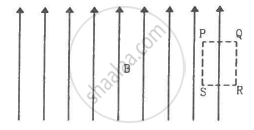
Sometimes we show an idealised magnetic field which is uniform in a given region and falls to zero abruptly. One such field is represented in figure. Using Ampere's law over the path PQRS, show that such a field is not possible.
Two identical current carrying coaxial loops, carry current I in opposite sense. A simple amperian loop passes through both of them once. Calling the loop as C, then which statement is correct?
A thick current carrying cable of radius ‘R’ carries current ‘I’ uniformly distributed across its cross-section. The variation of magnetic field B(r) due to the cable with the distance ‘r’ from the axis of the cable is represented by ______
Which law provides a simpler alternative method for finding the magnetic field \[B\] when the current distribution has symmetry (straight wire, solenoid, toroid)?
In the sign convention for Ampere's law, if the fingers of the right hand curl along the direction of integration (\[d\vec{l}\]), the thumb points:
According to the right-hand rule sign convention for Ampere's law, currents flowing in the direction of the thumb are taken as ______ and currents flowing opposite to it are taken as ______.
