Advertisements
Advertisements
प्रश्न
What is magnetic permeability?
Advertisements
उत्तर
Magnetic permeability can be defined as the measure of the ability of the material to allow the passage of magnetic field lines through it or a measure of the capacity of the substance to take magnetisation or the degree of penetration of the magnetic field through the substance.
APPEARS IN
संबंधित प्रश्न
Write Maxwell's generalization of Ampere's circuital law. Show that in the process of charging a capacitor, the current produced within the plates of the capacitor is `I=varepsilon_0 (dphi_E)/dt,`where ΦE is the electric flux produced during charging of the capacitor plates.
Electron drift speed is estimated to be of the order of mm s−1. Yet large current of the order of few amperes can be set up in the wire. Explain briefly.
Obtain an expression for magnetic induction along the axis of the toroid.
In Ampere's \[\oint \vec{B} \cdot d \vec{l} = \mu_0 i,\] the current outside the curve is not included on the right hand side. Does it mean that the magnetic field B calculated by using Ampere's law, gives the contribution of only the currents crossing the area bounded by the curve?
A thin but long, hollow, cylindrical tube of radius r carries i along its length. Find the magnitude of the magnetic field at a distance r/2 from the surface (a) inside the tube (b) outside the tube.
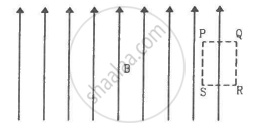
Sometimes we show an idealised magnetic field which is uniform in a given region and falls to zero abruptly. One such field is represented in figure. Using Ampere's law over the path PQRS, show that such a field is not possible.
Calculate the magnetic field inside and outside of the long solenoid using Ampere’s circuital law
Briefly explain various ways to increase the strength of the magnetic field produced by a given solenoid.
According to Ampere's Circuital Law, the line integral \[\oint\vec{B}\cdot d\vec{l}\] taken around any closed loop equals:
