Advertisements
Advertisements
प्रश्न
Read the following paragraph and answer the questions.
| The figure shows the variation of photoelectric current measured in a photocell circuit as a function of the potential difference between the plates of the photocell when light beams A, B, C and D of different wavelengths are incident on the photocell. Examine the given figure and answer the following questions: |

- Which light beam has the highest frequency and why?
- Which light beam has the longest wavelength and why?
- Which light beam ejects photoelectrons with maximum momentum and why?
Advertisements
उत्तर
(i) We know that the stopping potential and frequency are related as
V = `((hf - phi))/q`
Where Φ is the work function defined as the amount of energy needed to bind the electrons in the metals, hf is the energy of photons, and q is the charge.
This relationship leads us to the conclusion that the greater negative the stopping potential, the higher the frequency. As a result, curve B has the highest frequency and the largest negative stopping potential in the graph.
(ii) We all know that the connection between wavelength and frequency is inverse. The wavelength reduces as the frequency rises and vice versa.
As can be seen from the graph, C has the lowest frequency out of all the possible values since its stopping potential is the least negative. Therefore, the wavelength is largest when the frequency is lowest. C has the longest wavelength as a result.
(iii) Highest momentum means highest kinetic energy which can be calculated with the help of velocity.
kinetic energy = `1/2mv^2`
Relation to the momentum, p2 = 2m(K.E.)
If kinetic energy is maximum, then momentum will be maximum.
We know that the stopping potential and frequency are related,
Vq = (hf - Φ)
The maximum kinetic energy of the electrons equals the stopping voltage when measured in electron volt. We can consider Φ as the kinetic energy.
Kinetic energy is maximum when the frequency is maximum and in the above part we have seen that it is maximum for curve B, so momentum is maximum for curve B.
APPEARS IN
संबंधित प्रश्न
Can we find the mass of a photon by the definition p = mv?
If the frequency of light in a photoelectric experiment is doubled, the stopping potential will ______.
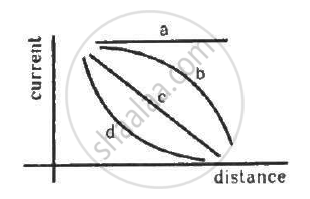
A point source causes photoelectric effect from a small metal plate. Which of the following curves may represent the saturation photocurrent as a function of the distance between the source and the metal?
Calculate the number of photons emitted per second by a 10 W sodium vapour lamp. Assume that 60% of the consumed energy is converted into light. Wavelength of sodium light = 590 nm
(Use h = 6.63 × 10⁻³⁴J-s = 4.14 × 10⁻¹⁵ eV-s, c = 3 × 10⁸ m/s and me = 9.1 × 10⁻³¹kg)
A 100 W light bulb is placed at the centre of a spherical chamber of radius 20 cm. Assume that 60% of the energy supplied to the bulb is converted into light and that the surface of the chamber is perfectly absorbing. Find the pressure exerted by the light on the surface of the chamber.
(Use h = 6.63 × 10⁻³⁴J-s = 4.14 × 10⁻¹⁵ eV-s, c = 3 × 10⁸ m/s and me = 9.1 × 10⁻³¹kg)
- Assertion (A): For the radiation of a frequency greater than the threshold frequency, the photoelectric current is proportional to the intensity of the radiation.
- Reason (R): Greater the number of energy quanta available, the greater the number of electrons absorbing the energy quanta and the greater the number of electrons coming out of the metal.
Which apparatus measures photocurrent?
Which radiation does quartz window W especially allow to enter the tube?
Between which two parts is a potential difference applied?
For frequencies above the threshold, how does photocurrent change with increasing incident light intensity?
