Advertisements
Advertisements
प्रश्न
In which of the following situations, the heavier of the two particles has smaller de Broglie wavelength? The two particles
(a) move with the same speed
(b) move with the same linear momentum
(c) move with the same kinetic energy
(d) have fallen through the same height
Advertisements
उत्तर
(a) move with the same speed
(c) move with the same kinetic energy
(d) have fallen through the same height
Let m1 be the mass of the heavier particle and m2 be the mass of the lighter particle.
If both the particles are moving with the same speed v, de Broglie wavelength of the heavier particle,
`λ_1 = h/(m_1v)` ....(1)
de Broglie wavelength of the lighter particle,
`λ_2 = h/(m_2v)` ....(2)
Thus, from equations (1) and (2), we find that if the particles are moving with the same speed v, then `λ_1< λ_2`.
Hence, option (a) is correct.
If they are moving with the same linear momentum, then using the de Broglie relation `λ = h/p`
We find that both the bodies will have the same wavelength. Hence, option (b) is incorrect.
If K is the kinetic energy of both the particles, then de Broglie wavelength of the heavier particle,
`λ_1 = h/sqrt(2m_1K)`
de Broglie wavelength of the lighter particle,
`λ_2 = h/sqrt(2m_2K)`
It is clear from the above equation that if `m_1 > m_2` , then `λ_1 < λ_2`.
Hence, option (c) is correct.
When they have fallen through the same height h, then velocity of both the bodies,
`v = sqrt(2gh)`
Now ,
`λ_1 = h/(m_1sqrt(2gh)`
`λ_2 = h/(m_2sqrt(2gh)`
`m_1>m_2`
`therefore λ_1 < λ_2`
Hence, option (d) is correct.
APPEARS IN
संबंधित प्रश्न
The photoelectric cut-off voltage in a certain experiment is 1.5 V. What is the maximum kinetic energy of photoelectrons emitted?
(a) Estimate the speed with which electrons emitted from a heated emitter of an evacuated tube impinge on the collector maintained at a potential difference of 500 V with respect to the emitter. Ignore the small initial speeds of the electrons. The specific charge of the electron, i.e., its e/m is given to be 1.76 × 10¹¹ C kg−1.
(b) Use the same formula you employ in (a) to obtain electron speed for an collector potential of 10 MV. Do you see what is wrong? In what way is the formula to be modified?
Monochromatic radiation of wavelength 640.2 nm (1 nm = 10−9 m) from a neon lamp irradiates photosensitive material made of caesium on tungsten. The stopping voltage is measured to be 0.54 V. The source is replaced by an iron source and its 427.2 nm line irradiates the same photo-cell. Predict the new stopping voltage.
The following graph shows the variation of photocurrent for a photosensitive metal :
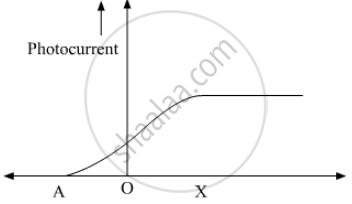
(a) Identify the variable X on the horizontal axis.
(b) What does the point A on the horizontal axis represent?
(c) Draw this graph for three different values of frequencies of incident radiation v1, v2 and v3 (v1 > v2 > v3) for same intensity.
(d) Draw this graph for three different values of intensities of incident radiation I1, I2 and I3 (I1 > I2 > I3) having same frequency.
Two photons of
A sphere of radius 1.00 cm is placed in the path of a parallel beam of light of large aperture. The intensity of the light is 0.5 W cm−2. If the sphere completely absorbs the radiation falling on it, Show that the force on the sphere due to the light falling on it is the same even if the sphere is not perfectly absorbing.
Show that it is not possible for a photon to be completely absorbed by a free electron.
The electric field associated with a monochromatic beam is 1.2 × 10¹⁵ times per second. Find the maximum kinetic energy of the photoelectrons when this light falls on a metal surface whose work function is 2.0 eV.
(Use h = 6.63 × 10⁻³⁴J-s = 4.14 × 10⁻¹⁵ eV-s, c = 3 × 10⁸ m/s and me = 9.1 × 10⁻³¹kg)
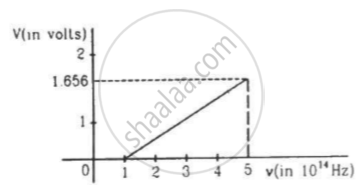
The figure is the plot of stopping potential versus the frequency of the light used in an experiment on photoelectric effect. Find (a) the ratio h/e and (b) the work function.
Define the term: stopping potential in the photoelectric effect.
Two monochromatic beams A and B of equal intensity I, hit a screen. The number of photons hitting the screen by beam A is twice that by beam B. Then what inference can you make about their frequencies?
How would the stopping potential for a given photosensitive surface change if the intensity of incident radiation was decreased? Justify your answer.
What is the effect of threshold frequency and stopping potential on increasing the frequency of the incident beam of light? Justify your answer.
Which apparatus provides monochromatic radiation for illuminating emitter plate C?
What does emitter plate C do when light falls on it?
How does collector plate A help measure current?
What happens when the collector is made negative with respect to the emitter?
When are photoelectrons emitted in relation to the threshold frequency?
