Advertisements
Advertisements
Question
In which of the following situations, the heavier of the two particles has smaller de Broglie wavelength? The two particles
(a) move with the same speed
(b) move with the same linear momentum
(c) move with the same kinetic energy
(d) have fallen through the same height
Advertisements
Solution
(a) move with the same speed
(c) move with the same kinetic energy
(d) have fallen through the same height
Let m1 be the mass of the heavier particle and m2 be the mass of the lighter particle.
If both the particles are moving with the same speed v, de Broglie wavelength of the heavier particle,
`λ_1 = h/(m_1v)` ....(1)
de Broglie wavelength of the lighter particle,
`λ_2 = h/(m_2v)` ....(2)
Thus, from equations (1) and (2), we find that if the particles are moving with the same speed v, then `λ_1< λ_2`.
Hence, option (a) is correct.
If they are moving with the same linear momentum, then using the de Broglie relation `λ = h/p`
We find that both the bodies will have the same wavelength. Hence, option (b) is incorrect.
If K is the kinetic energy of both the particles, then de Broglie wavelength of the heavier particle,
`λ_1 = h/sqrt(2m_1K)`
de Broglie wavelength of the lighter particle,
`λ_2 = h/sqrt(2m_2K)`
It is clear from the above equation that if `m_1 > m_2` , then `λ_1 < λ_2`.
Hence, option (c) is correct.
When they have fallen through the same height h, then velocity of both the bodies,
`v = sqrt(2gh)`
Now ,
`λ_1 = h/(m_1sqrt(2gh)`
`λ_2 = h/(m_2sqrt(2gh)`
`m_1>m_2`
`therefore λ_1 < λ_2`
Hence, option (d) is correct.
APPEARS IN
RELATED QUESTIONS
Define the term 'intensity of radiation' in terms of photon picture of light.
The following graph shows the variation of photocurrent for a photosensitive metal :
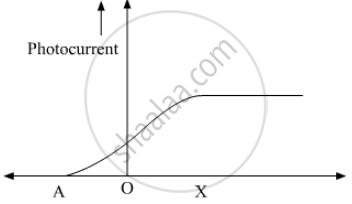
(a) Identify the variable X on the horizontal axis.
(b) What does the point A on the horizontal axis represent?
(c) Draw this graph for three different values of frequencies of incident radiation v1, v2 and v3 (v1 > v2 > v3) for same intensity.
(d) Draw this graph for three different values of intensities of incident radiation I1, I2 and I3 (I1 > I2 > I3) having same frequency.
Should the energy of a photon be called its kinetic energy or its internal energy?
In an experiment on photoelectric effect, a photon is incident on an electron from one direction and the photoelectron is emitted almost in the opposite direction. Does this violate the principle of conservation of momentum?
It is found that yellow light does not eject photoelectrons from a metal. Is it advisable to try with orange light or with green light?
It is found that photosynthesis starts in certain plants when exposed to sunlight, but it does not start if the plants are exposed only to infrared light. Explain.
Calculate the momentum of a photon of light of wavelength 500 nm.
(Use h = 6.63 × 10⁻³⁴J-s = 4.14 × 10⁻¹⁵ eV-s, c = 3 × 10⁸ m/s and me = 9.1 × 10⁻³¹kg)
When the sun is directly overhead, the surface of the earth receives 1.4 × 10³ W m−2 of sunlight. Assume that the light is monochromatic with average wavelength 500 nm and that no light is absorbed in between the sun and the earth's surface. The distance between the sun and the earth is 1.5 × 10¹¹ m. (a) Calculate the number of photons falling per second on each square metre of earth's surface directly below the sun. (b) How many photons are there in each cubic metre near the earth's surface at any instant? (c) How many photons does the sun emit per second?
(Use h = 6.63 × 10⁻³⁴J-s = 4.14 × 10⁻¹⁵ eV-s, c = 3 × 10⁸ m/s and me = 9.1 × 10⁻³¹kg)
A parallel beam of monochromatic light of wavelength 663 nm is incident on a totally reflecting plane mirror. The angle of incidence is 60° and the number of photons striking the mirror per second is 1.0 × 10¹⁹. Calculate the force exerted by the light beam on the mirror.
(Use h = 6.63 × 10⁻³⁴J-s = 4.14 × 10⁻¹⁵ eV-s, c = 3 × 10⁸ m/s and me = 9.1 × 10⁻³¹kg)
Find the maximum kinetic energy of the photoelectrons ejected when light of wavelength 350 nm is incident on a cesium surface. Work function of cesium = 1.9 eV
(Use h = 6.63 × 10⁻³⁴J-s = 4.14 × 10⁻¹⁵ eV-s, c = 3 × 10⁸ m/s and me = 9.1 × 10⁻³¹kg)
The electric field associated with a monochromatic beam is 1.2 × 10¹⁵ times per second. Find the maximum kinetic energy of the photoelectrons when this light falls on a metal surface whose work function is 2.0 eV.
(Use h = 6.63 × 10⁻³⁴J-s = 4.14 × 10⁻¹⁵ eV-s, c = 3 × 10⁸ m/s and me = 9.1 × 10⁻³¹kg)
The electric field associated with a light wave is given by `E = E_0 sin [(1.57 xx 10^7 "m"^-1)(x - ct)]`. Find the stopping potential when this light is used in an experiment on photoelectric effect with the emitter having work function 1.9 eV.
(Use h = 6.63 × 10⁻³⁴J-s = 4.14 × 10⁻¹⁵ eV-s, c = 3 × 10⁸ m/s and me = 9.1 × 10⁻³¹kg)
The work function for a metal surface is 4.14 eV. The threshold wavelength for this metal surface is ______.
Which of the following options represents the variation of photoelectric current with property of light shown on the x-axis?
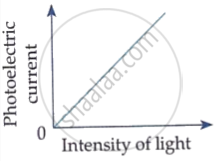
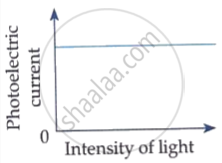
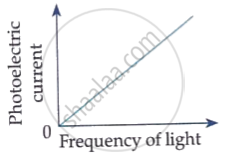
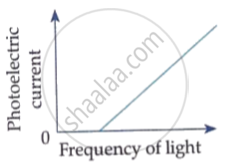
Which three factors are varied to examine how photocurrent behaves?
Which theory cannot completely explain important observations of photoelectric emission?
Which radiation does quartz window W especially allow to enter the tube?
What type of potential can the battery create between the plates?
After applying a potential difference, how is the resulting photocurrent measured?
Which observation was one of the major difficulties for classical wave theory?
