Advertisements
Advertisements
प्रश्न
In which of the following situations, the heavier of the two particles has smaller de Broglie wavelength? The two particles
(a) move with the same speed
(b) move with the same linear momentum
(c) move with the same kinetic energy
(d) have fallen through the same height
Advertisements
उत्तर
(a) move with the same speed
(c) move with the same kinetic energy
(d) have fallen through the same height
Let m1 be the mass of the heavier particle and m2 be the mass of the lighter particle.
If both the particles are moving with the same speed v, de Broglie wavelength of the heavier particle,
`λ_1 = h/(m_1v)` ....(1)
de Broglie wavelength of the lighter particle,
`λ_2 = h/(m_2v)` ....(2)
Thus, from equations (1) and (2), we find that if the particles are moving with the same speed v, then `λ_1< λ_2`.
Hence, option (a) is correct.
If they are moving with the same linear momentum, then using the de Broglie relation `λ = h/p`
We find that both the bodies will have the same wavelength. Hence, option (b) is incorrect.
If K is the kinetic energy of both the particles, then de Broglie wavelength of the heavier particle,
`λ_1 = h/sqrt(2m_1K)`
de Broglie wavelength of the lighter particle,
`λ_2 = h/sqrt(2m_2K)`
It is clear from the above equation that if `m_1 > m_2` , then `λ_1 < λ_2`.
Hence, option (c) is correct.
When they have fallen through the same height h, then velocity of both the bodies,
`v = sqrt(2gh)`
Now ,
`λ_1 = h/(m_1sqrt(2gh)`
`λ_2 = h/(m_2sqrt(2gh)`
`m_1>m_2`
`therefore λ_1 < λ_2`
Hence, option (d) is correct.
APPEARS IN
संबंधित प्रश्न
The following graph shows the variation of photocurrent for a photosensitive metal :
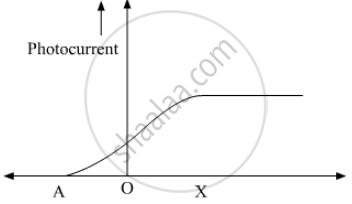
(a) Identify the variable X on the horizontal axis.
(b) What does the point A on the horizontal axis represent?
(c) Draw this graph for three different values of frequencies of incident radiation v1, v2 and v3 (v1 > v2 > v3) for same intensity.
(d) Draw this graph for three different values of intensities of incident radiation I1, I2 and I3 (I1 > I2 > I3) having same frequency.
If the wavelength of light in an experiment on photoelectric effect is doubled,
(a) photoelectric emission will not take place
(b) photoelectric emission may or may not take place
(c) the stopping potential will increase
(d) the stopping potential will decrease
The collector plate in an experiment on photoelectric effect is kept vertically above the emitter plate. A light source is put on and a saturation photocurrent is recorded. An electric field is switched on that has a vertically downward direction.
An atom absorbs a photon of wavelength 500 nm and emits another photon of wavelength 700 nm. Find the net energy absorbed by the atom in the process.
(Use h = 6.63 × 10⁻³⁴J-s = 4.14 × 10⁻¹⁵ eV-s, c = 3 × 10⁸ m/s and me = 9.1 × 10⁻³¹kg)
Calculate the number of photons emitted per second by a 10 W sodium vapour lamp. Assume that 60% of the consumed energy is converted into light. Wavelength of sodium light = 590 nm
(Use h = 6.63 × 10⁻³⁴J-s = 4.14 × 10⁻¹⁵ eV-s, c = 3 × 10⁸ m/s and me = 9.1 × 10⁻³¹kg)
The work function of a metal is 2.5 × 10⁻¹⁹ J. (a) Find the threshold frequency for photoelectric emission. (b) If the metal is exposed to a light beam of frequency 6.0 × 10¹⁴ Hz, what will be the stopping potential?
(Use h = 6.63 × 10⁻³⁴J-s = 4.14 × 10⁻¹⁵ eV-s, c = 3 × 10⁸ m/s and me = 9.1 × 10⁻³¹kg)
The electric field associated with a light wave is given by `E = E_0 sin [(1.57 xx 10^7 "m"^-1)(x - ct)]`. Find the stopping potential when this light is used in an experiment on photoelectric effect with the emitter having work function 1.9 eV.
(Use h = 6.63 × 10⁻³⁴J-s = 4.14 × 10⁻¹⁵ eV-s, c = 3 × 10⁸ m/s and me = 9.1 × 10⁻³¹kg)
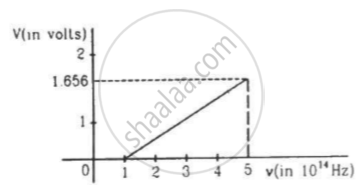
The figure is the plot of stopping potential versus the frequency of the light used in an experiment on photoelectric effect. Find (a) the ratio h/e and (b) the work function.
In the case of photoelectric effect experiment, explain the following facts, giving reasons.
The photoelectric current increases with increase of intensity of incident light.
In photoelectric effect, the photoelectric current started to flow. This means that the frequency of incident radiations is ______.
Do all the electrons that absorb a photon come out as photoelectrons?
Consider a metal exposed to light of wavelength 600 nm. The maximum energy of the electron doubles when light of wavelength 400 nm is used. Find the work function in eV.
Consider a thin target (10–2 cm square, 10–3 m thickness) of sodium, which produces a photocurrent of 100 µA when a light of intensity 100W/m2 (λ = 660 nm) falls on it. Find the probability that a photoelectron is produced when a photons strikes a sodium atom. [Take density of Na = 0.97 kg/m3].
Read the following paragraph and answer the questions.
| The figure shows the variation of photoelectric current measured in a photocell circuit as a function of the potential difference between the plates of the photocell when light beams A, B, C and D of different wavelengths are incident on the photocell. Examine the given figure and answer the following questions: |

- Which light beam has the highest frequency and why?
- Which light beam has the longest wavelength and why?
- Which light beam ejects photoelectrons with maximum momentum and why?
A metallic plate exposed to white light emits electrons. For which of the following colours of light, the stopping potential will be maximum?
Which theory cannot completely explain important observations of photoelectric emission?
Which apparatus measures photocurrent?
What does emitter plate C do when light falls on it?
What is used to change light frequency and study its effect on emission and electron energy?
