Advertisements
Advertisements
प्रश्न
The work function of a photoelectric material is 4.0 eV. (a) What is the threshold wavelength? (b) Find the wavelength of light for which the stopping potential is 2.5 V.
(Use h = 6.63 × 10⁻³⁴J-s = 4.14 × 10⁻¹⁵ eV-s, c = 3 × 10⁸ m/s and me = 9.1 × 10⁻³¹kg)
Advertisements
उत्तर
Work function of a photoelectric material, ϕ = 4 eV = 4 × 1.6 × 10−19 J
Stopping potential, V0 = 2.5 V
Planck's constant, `h = 6.63 xx 10^-34 "Js"`
(a) Work function of a photoelectric material,
`phi = (hc)/λ_0`
Here, λ0 = threshold wavelength of light
c = speed of light
`therefore λ_0 = (hc)/phi`
`λ_0 = (6.63 xx 10^-34 xx 3 xx 10^8)/(4 xx 1.6 xx 10^-19)`
`λ_0 = (6.63 xx 3)/64 xx (10^27)/(10^-9)`
`λ_0 = 3.1 xx 10^-7 "m"`
`λ_0 = 310 "nm"`
(b) From Einstein's photoelectric equation,
`E = phi + eV_0`
On substituting the respective values , we get :-
`(hc)/λ = 4 xx 1.6 xx 10^-19 + 1.6 xx 10^-19 xx 2.5`
`⇒ λ = (6.63 xx 10^-34 xx 3 xx 10^8)/(6.5 xx 1.6 xx 10^-19)`
`⇒ λ = (6.63 xx 3 xx 10^-26)/(1.6 xx 10^-19 xx 6.5)`
`⇒ λ = 1.9125 xx 10^-7 = 191 "nm"`
APPEARS IN
संबंधित प्रश्न
A mercury lamp is a convenient source for studying frequency dependence of photoelectric emission, since it gives a number of spectral lines ranging from the UV to the red end of the visible spectrum. In our experiment with rubidium photo-cell, the following lines from a mercury source were used:
λ1 = 3650 Å, λ2 = 4047 Å, λ3 = 4358 Å, λ4 = 5461 Å, λ5 = 6907 Å,
The stopping voltages, respectively, were measured to be:
V01 = 1.28 V, V02 = 0.95 V, V03 = 0.74 V, V04 = 0.16 V, V05 = 0 V
Determine the value of Planck’s constant h, the threshold frequency and work function for the material.
[Note: You will notice that to get h from the data, you will need to know e (which you can take to be 1.6 × 10⁻¹⁹ C). Experiments of this kind on Na, Li, K, etc. were performed by Millikan, who, using his own value of e (from the oil-drop experiment) confirmed Einstein’s photoelectric equation and at the same time gave an independent estimate of the value of h.]
Light of intensity 10−5 W m−2 falls on a sodium photo-cell of surface area 2 cm2. Assuming that the top 5 layers of sodium absorb the incident energy, estimate time required for photoelectric emission in the wave-picture of radiation. The work function for the metal is given to be about 2 eV. What is the implication of your answer?
It is found that photosynthesis starts in certain plants when exposed to sunlight, but it does not start if the plants are exposed only to infrared light. Explain.
The equation E = pc is valid
A point source of light is used in a photoelectric effect. If the source is removed farther from the emitting metal, the stopping potential
Photoelectric effect supports quantum nature of light because
(a) there is a minimum frequency below which no photoelectrons are emitted
(b) the maximum kinetic energy of photoelectrons depends only on the frequency of light and not on its intensity
(c) even when the metal surface is faintly illuminated the photoelectrons leave the surface immediately
(d) electric charge of the photoelectrons is quantised
Calculate the momentum of a photon of light of wavelength 500 nm.
(Use h = 6.63 × 10⁻³⁴J-s = 4.14 × 10⁻¹⁵ eV-s, c = 3 × 10⁸ m/s and me = 9.1 × 10⁻³¹kg)
Calculate the number of photons emitted per second by a 10 W sodium vapour lamp. Assume that 60% of the consumed energy is converted into light. Wavelength of sodium light = 590 nm
(Use h = 6.63 × 10⁻³⁴J-s = 4.14 × 10⁻¹⁵ eV-s, c = 3 × 10⁸ m/s and me = 9.1 × 10⁻³¹kg)
A parallel beam of monochromatic light of wavelength 663 nm is incident on a totally reflecting plane mirror. The angle of incidence is 60° and the number of photons striking the mirror per second is 1.0 × 10¹⁹. Calculate the force exerted by the light beam on the mirror.
(Use h = 6.63 × 10⁻³⁴J-s = 4.14 × 10⁻¹⁵ eV-s, c = 3 × 10⁸ m/s and me = 9.1 × 10⁻³¹kg)
Find the maximum kinetic energy of the photoelectrons ejected when light of wavelength 350 nm is incident on a cesium surface. Work function of cesium = 1.9 eV
(Use h = 6.63 × 10⁻³⁴J-s = 4.14 × 10⁻¹⁵ eV-s, c = 3 × 10⁸ m/s and me = 9.1 × 10⁻³¹kg)
The electric field associated with a monochromatic beam is 1.2 × 10¹⁵ times per second. Find the maximum kinetic energy of the photoelectrons when this light falls on a metal surface whose work function is 2.0 eV.
(Use h = 6.63 × 10⁻³⁴J-s = 4.14 × 10⁻¹⁵ eV-s, c = 3 × 10⁸ m/s and me = 9.1 × 10⁻³¹kg)
The electric field associated with a light wave is given by `E = E_0 sin [(1.57 xx 10^7 "m"^-1)(x - ct)]`. Find the stopping potential when this light is used in an experiment on photoelectric effect with the emitter having work function 1.9 eV.
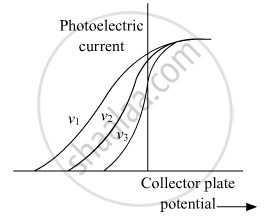
On the basis of the graphs shown in the figure, answer the following questions :
(a) Which physical parameter is kept constant for the three curves?
(b) Which is the highest frequency among v1, v2, and v3?
Read the following paragraph and answer the questions.
| The figure shows the variation of photoelectric current measured in a photocell circuit as a function of the potential difference between the plates of the photocell when light beams A, B, C and D of different wavelengths are incident on the photocell. Examine the given figure and answer the following questions: |

- Which light beam has the highest frequency and why?
- Which light beam has the longest wavelength and why?
- Which light beam ejects photoelectrons with maximum momentum and why?
What is the effect of threshold frequency and stopping potential on increasing the frequency of the incident beam of light? Justify your answer.
Which three factors are varied to examine how photocurrent behaves?
Which apparatus applies a potential difference between the plates?
After applying a potential difference, how is the resulting photocurrent measured?
Why is the polarity reversed during the procedure?
