Advertisements
Advertisements
प्रश्न
The work function of a photoelectric material is 4.0 eV. (a) What is the threshold wavelength? (b) Find the wavelength of light for which the stopping potential is 2.5 V.
(Use h = 6.63 × 10⁻³⁴J-s = 4.14 × 10⁻¹⁵ eV-s, c = 3 × 10⁸ m/s and me = 9.1 × 10⁻³¹kg)
Advertisements
उत्तर
Work function of a photoelectric material, ϕ = 4 eV = 4 × 1.6 × 10−19 J
Stopping potential, V0 = 2.5 V
Planck's constant, `h = 6.63 xx 10^-34 "Js"`
(a) Work function of a photoelectric material,
`phi = (hc)/λ_0`
Here, λ0 = threshold wavelength of light
c = speed of light
`therefore λ_0 = (hc)/phi`
`λ_0 = (6.63 xx 10^-34 xx 3 xx 10^8)/(4 xx 1.6 xx 10^-19)`
`λ_0 = (6.63 xx 3)/64 xx (10^27)/(10^-9)`
`λ_0 = 3.1 xx 10^-7 "m"`
`λ_0 = 310 "nm"`
(b) From Einstein's photoelectric equation,
`E = phi + eV_0`
On substituting the respective values , we get :-
`(hc)/λ = 4 xx 1.6 xx 10^-19 + 1.6 xx 10^-19 xx 2.5`
`⇒ λ = (6.63 xx 10^-34 xx 3 xx 10^8)/(6.5 xx 1.6 xx 10^-19)`
`⇒ λ = (6.63 xx 3 xx 10^-26)/(1.6 xx 10^-19 xx 6.5)`
`⇒ λ = 1.9125 xx 10^-7 = 191 "nm"`
APPEARS IN
संबंधित प्रश्न
(a) Estimate the speed with which electrons emitted from a heated emitter of an evacuated tube impinge on the collector maintained at a potential difference of 500 V with respect to the emitter. Ignore the small initial speeds of the electrons. The specific charge of the electron, i.e., its e/m is given to be 1.76 × 10¹¹ C kg−1.
(b) Use the same formula you employ in (a) to obtain electron speed for an collector potential of 10 MV. Do you see what is wrong? In what way is the formula to be modified?
Ultraviolet light of wavelength 2271 Å from a 100 W mercury source irradiates a photo-cell made of molybdenum metal. If the stopping potential is −1.3 V, estimate the work function of the metal. How would the photo-cell respond to a high intensity (∼105 W m−2) red light of wavelength 6328 Å produced by a He-Ne laser?
Monochromatic radiation of wavelength 640.2 nm (1 nm = 10−9 m) from a neon lamp irradiates photosensitive material made of caesium on tungsten. The stopping voltage is measured to be 0.54 V. The source is replaced by an iron source and its 427.2 nm line irradiates the same photo-cell. Predict the new stopping voltage.
The work function for the following metals is given:
Na: 2.75 eV; K: 2.30 eV; Mo: 4.17 eV; Ni: 5.15 eV
Which of these metals will not give photoelectric emission for a radiation of wavelength 3300 Å from a He-Cd laser placed 1 m away from the photocell? What happens if the laser is brought nearer and placed 50 cm away?
The threshold wavelength of a metal is λ0. Light of wavelength slightly less than λ0 is incident on an insulated plate made of this metal. It is found that photoelectrons are emitted for some time and after that the emission stops. Explain.
Planck's constant has the same dimensions as
The work function of a metal is hv0. Light of frequency v falls on this metal. Photoelectric effect will take place only if
Light of wavelength λ falls on a metal with work-function hc/λ0. Photoelectric effect will take place only if
When a metal plate is exposed to a monochromatic beam of light of wavelength 400 nm, a negative potential of 1.1 V is needed to stop the photo current. Find the threshold wavelength for the metal.
(Use h = 6.63 × 10⁻³⁴J-s = 4.14 × 10⁻¹⁵ eV-s, c = 3 × 10⁸ m/s and me = 9.1 × 10⁻³¹kg)
Answer the following question.
Plot a graph of photocurrent versus anode potential for radiation of frequency ν and intensities I1 and I2 (I1 < I2).
Consider a metal exposed to light of wavelength 600 nm. The maximum energy of the electron doubles when light of wavelength 400 nm is used. Find the work function in eV.
Consider a thin target (10–2 cm square, 10–3 m thickness) of sodium, which produces a photocurrent of 100 µA when a light of intensity 100W/m2 (λ = 660 nm) falls on it. Find the probability that a photoelectron is produced when a photons strikes a sodium atom. [Take density of Na = 0.97 kg/m3].
The work function for a metal surface is 4.14 eV. The threshold wavelength for this metal surface is ______.
The figure shows a plot of stopping potential (V0) versus `1/lambda`, where λ is the wavelength of the radiation causing photoelectric emission from a surface. The slope of the line is equal to ______.

What is the effect of threshold frequency and stopping potential on increasing the frequency of the incident beam of light? Justify your answer.
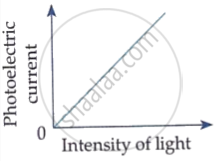
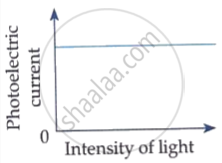
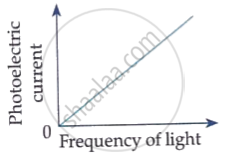
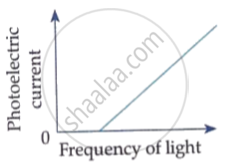
Which of the following options represents the variation of photoelectric current with property of light shown on the x-axis?
Which apparatus measures the potential difference?
What is used to change light frequency and study its effect on emission and electron energy?
What happens if the frequency of incident radiation is below the threshold frequency?
